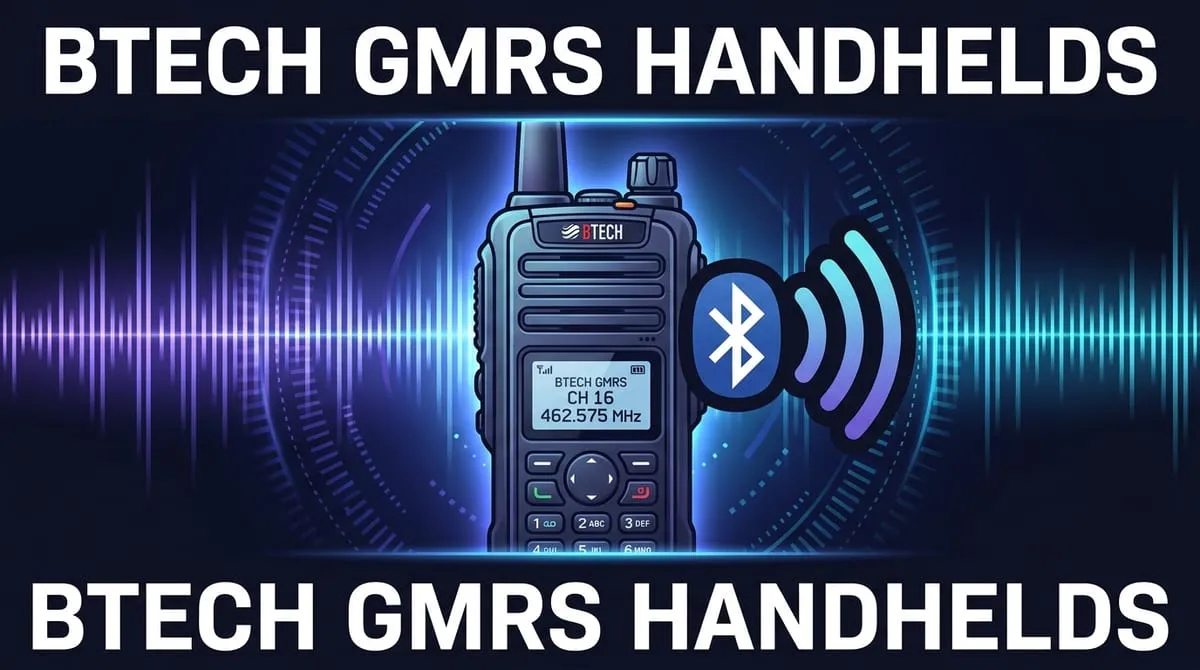
This guide compares BTECH GMRS handheld radios sold in the U.S. It focuses strictly on FCC Part 95E certified models—covering app features, weather sealing, repeater access, and how BTECH’s GMRS lineup differs from generic BaoFeng imports.
Why I Built This
People frequently mix up BaoFeng and BTECH (BaoFeng Tech), assuming they are the exact same company.
They are not. While BTECH started by customizing imported BaoFeng hardware, BTECH is an independent U.S.-based company out of South Dakota. They design custom firmware, build dedicated iOS and Android apps, obtain separate FCC equipment grants, and provide domestic customer support.
However, shopping across BTECH’s product catalog can still be confusing:
- Official BTECH product pages
- Retailer product descriptions
- FCC certification filings
- User manuals and programming guides
- Forum discussions and video reviews
Retail listings often lump GMRS handhelds together with MURS units or amateur radios (like the tri-band UV-5X3, which requires an amateur radio license to transmit). Other pages list features—like civil aviation Airband AM reception—that simply do not exist on BTECH GMRS handhelds.
I put this side-by-side reference together by compiling details from official technical documentation, FCC filings, user manuals, and verified operator feedback, focused strictly on GMRS handhelds.
What I Compared
I evaluated the core specs and features that impact daily GMRS operation:
- FCC Part 95E certification status
- Maximum transmit power output (5 W max)
- Ingress protection (IP67 submersible vs IP54 weatherproof)
- Bluetooth smartphone integration and app control
- Off-grid GPS location sharing and text data over GMRS
- USB-C direct battery charging
- Battery pack capacity
- Memory channel capacity and programming flexibility
- Airband (AM) and VHF/UHF FM scanner reception
- Dual Watch and Dual PTT controls
- NOAA weather scan and alert support
- CHIRP and BTECH Wireless App compatibility
- Primary practical use case
How I Compiled & Verified Specs
Every specification in this guide was cross-checked against:
- Official BTECH product manuals and documentation (
baofengtech.com) - FCC OET Equipment Authorization database filings (Grantee Code:
2AG7G) - CHIRP software driver code and frequency limits
- Verified community reports and operator reviews
When retailer marketing claims conflicted with technical documentation, official FCC filings and manufacturer manuals took precedence.
A Quick Example
Buyers frequently ask whether the BTECH GMRS-PRO or GMRS-V2 can receive civil aviation Airband (108–137 MHz AM).
Official user manuals and technical specs confirm that neither BTECH GMRS handheld includes Airband AM reception. While both scan standard VHF (136–174 MHz) and UHF (400–520 MHz) FM signals, their receivers lack the AM demodulation hardware required for aviation communications.
If Airband receive is a non-negotiable requirement for your kit, look at the Baofeng UV-5G PRO instead. Skip the UV-5G Mini here—Baofeng’s listing advertises 108–136 MHz, but testing a U.S. retail unit showed it has no AM demodulation, so aircraft traffic comes through as noise.
Scope
This comparison focuses strictly on BTECH’s GMRS handheld lineup:
- GMRS-PRO (Flagship Bluetooth & App GMRS Handheld)
- GMRS-V2 (Mainstream Customizable GMRS Handheld)
- GMRS-V1 (Legacy Classic GMRS Handheld)
It skips MURS handhelds (like the MURS-V2), FRS radios, amateur ham models (like the UV-5X3, which require a separate ham license), and commercial mobile units.
Comparison Table
Model names link directly to product pages on baofengtech.com (affiliate referral links that support this site at no extra cost to you).
| Feature | GMRS-PRO | GMRS-V2 | GMRS-V1 |
|---|---|---|---|
| Approx. Release | ~2022 | ~2022 | ~2016 |
| FCC Grant Status | ✅ Part 95E | ✅ Part 95E | ✅ Part 95E |
| Max GMRS Power | 5 W | 5 W | 5 W |
| Memory Channels | 180 (6 banks × 30) | 200 | 128 |
| GMRS Repeater Support | ✅ | ✅ | ✅ |
| Bluetooth / App Integration | ✅ iOS/Android | ❌ | ❌ |
| GPS / Off-Grid Location | ✅ Text & Location | ❌ | ❌ |
| Airband Receive (108-137 MHz AM) | ❌ | ❌ | ❌ |
| VHF/UHF FM Scanner Receive | ✅ (136-174 / 400-520) | ✅ (136-174 / 400-520) | ✅ (136-174 / 400-520) |
| NOAA Weather Scan | ✅ | ✅ | ✅ |
| FM Broadcast Radio | ✅ | ✅ | ✅ |
| Dual Watch / Dual PTT | ✅ Dual Watch | ✅ Dual PTT | ✅ Dual Watch |
| USB-C Charging | ✅ Direct Battery (USB-A→C cable) | ✅ Direct Battery | ❌ (Cradle default) |
| Battery Capacity | 2600 mAh | 1800 mAh | 1800 mAh |
| Removable Antenna | ❌ Not intended (see notes) | ✅ SMA-Female | ✅ SMA-Female |
| Waterproof Rating | IP67 Submersible | IP54 Weatherproof | Standard |
| Programming Options | BTECH App / CHIRP / PC | CHIRP / PC | CHIRP / PC |
| Primary Use Case | Tech & Off-Grid Tactical | Everyday Enthusiast | Classic Legacy |
GMRS Lineup Ranking
| Rank | Model | Why |
|---|---|---|
| 🥇 | GMRS-PRO | Top feature set: real IP67 sealing, Bluetooth app control, GPS location sharing, and a 2600 mAh USB-C battery. |
| 🥈 | GMRS-V2 | Best traditional GMRS pick. Offers 200 channels, IP54 weather resistance, dual PTT buttons, and direct USB-C charging. |
| 🥉 | GMRS-V1 | A proven classic that launched BTECH GMRS, but superseded by the V2’s USB-C pack and expanded channels. |
Product Tier
| Tier | Model |
|---|---|
| 🌟 Bluetooth Flagship | GMRS-PRO |
| 📻 Enthusiast Workhorse | GMRS-V2 |
| 🏛️ Legacy Classic | GMRS-V1 |
Notes
BTECH vs. Generic BaoFeng
BTECH (BaoFeng Tech) operates independently from generic factory-direct BaoFeng sellers. BTECH radios feature custom U.S. firmware builds, dedicated smartphone app software, separate FCC certifications, and local state-side support.
GMRS-PRO Data & Location Bursts
The GMRS-PRO allows sending short text messages and GPS coordinates to other GMRS-PRO units over the air without relying on cellular towers or internet connections. The BTECH App displays contacts on an offline map grid.
What the Data Features Cost You
The GMRS-PRO’s antenna is not meant to come off. A note on BTECH’s product page puts it this way: “the antenna is not removable. This is not a design flaw, but an FCC requirement due to the radio’s ability to transmit data.” Two caveats on that, because they matter: it appears in the page’s customer-review section rather than the spec sheet, and owners report units ranging from a firm twist to fully bonded. Treat it as a radio you should not plan to re-antenna, not as a published hard spec. Its USB-C port also wants a USB-A to USB-C cable—C-to-C charging is not supported, so pack the right cable.
No Airband AM Support
Unlike the Baofeng UV-5G PRO, none of BTECH’s GMRS handhelds support Airband AM (108–137 MHz) reception. Receiver scanning is strictly FM across the VHF and UHF bands.
Connector Compatibility
The GMRS-V1 and GMRS-V2 put an SMA-Male jack on the radio body, so the antenna half you screw on is SMA-Female—the same convention Baofeng uses, and the reverse of Yaesu and Icom. That is the label to look for when you order a Nagoya NA-771G or NA-701G.
The GMRS-PRO is the exception; see the note above on its antenna.