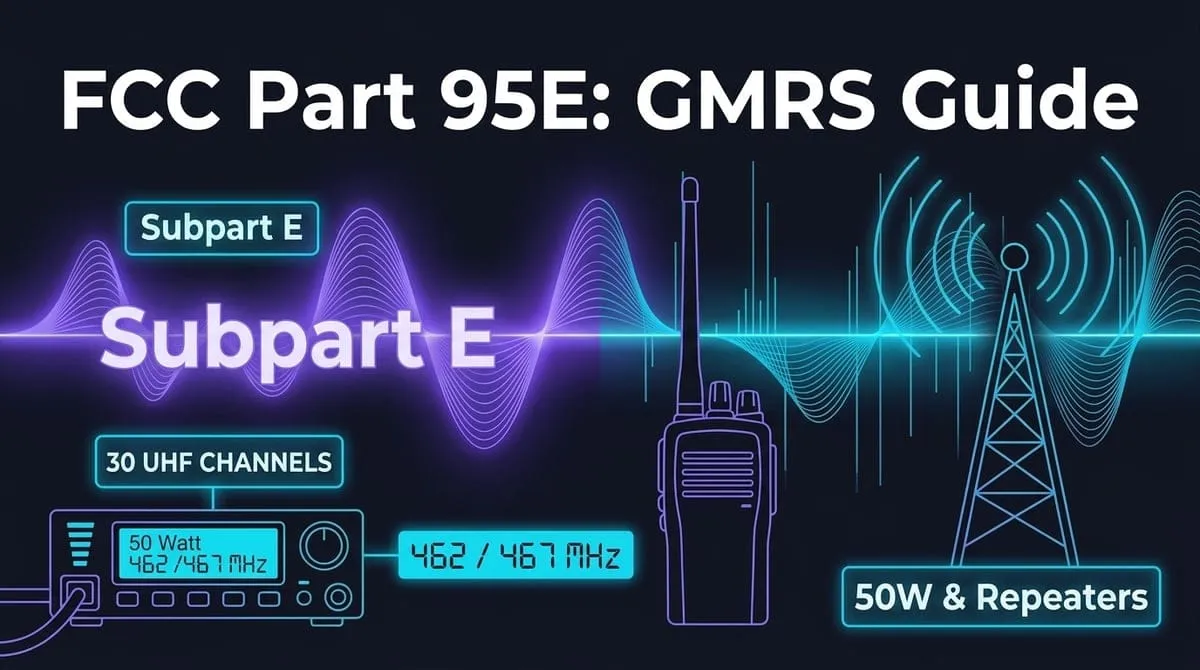
Whether you are rigging a 50-watt mobile unit into an off-road truck, setting up a base station antenna on your roof, or keying up a regional repeater from a handheld in the mountains, the General Mobile Radio Service hits the sweet spot of two-way communications. It offers significantly more power and range than license-free FRS, supports high-altitude repeaters and detachable antennas, and avoids the technical examinations required for an amateur radio license.
Behind the easy entry lies a comprehensive federal regulatory framework: Title 47, Part 95, Subpart E of the Code of Federal Regulations (47 CFR Part 95 Subpart E).
Subpart E is unique. It blends individual station licensing with broad family permissions, mixes shared simplex frequencies with dedicated repeater inputs, and pairs generous 50-watt transmitter power limits with strict ERP caps on interstitial channels. It also governs the technical boundaries of wideband FM audio, repeater duplexer engineering, call-sign identification, and limited handheld digital data.
This guide provides an exhaustive, practical breakdown of GMRS regulations and field engineering, translating federal rulebooks into actionable operating knowledge.
Primary Sources: Citations reflect current Title 47 Part 95 rules published in the eCFR, including the 2017 Part 95 Personal Radio Service Reform (FCC 17-57, 82 FR 41104), the fee schedule revision (FCC 20-184 / MD Docket 20-270, effective April 19, 2022), and the direct final certification cleanup order (FCC 25-77, 90 FR 57698, effective February 10, 2026).
01 · What GMRS Actually Is (§ 95.1703)
Under 47 CFR § 95.1703, the FCC defines GMRS as a mobile two-way voice communication service, with limited digital data applications, designed to facilitate the activities of individual licensees and their immediate family members. Emergency communications and traveler assistance are explicit statutory purposes of the service.
GMRS occupies a specific 30-frequency slice of the Ultra High Frequency (UHF) spectrum centered around 462 MHz and 467 MHz. Operating on UHF brings line-of-sight propagation characteristics: signals cut through urban structures and vehicle windows with minimal attenuation compared to HF, but require optical line-of-sight or favorable terrain diffraction to span long distances.
To understand where GMRS fits among personal radio services, look at how it compares to its two closest Part 95 cousins:
| Operational Feature | FRS (Subpart B) | GMRS (Subpart E) | CB (Subpart D) |
|---|---|---|---|
| Authorization Model | Licensed by Rule (§ 95.305) | Individual License (§ 95.1705) | Licensed by Rule (§ 95.305) |
| Frequency Pool | 22 Shared UHF Channels | 30 Frequencies (22 Shared + 8 Repeater Inputs) | 40 Dedicated HF Channels (27 MHz) |
| Repeater Capabilities | Strictly Prohibited | Full Duplex Repeater Operation Permitted | No Duplex Repeaters |
| Antenna Flexibility | Fixed Integral Only (Non-removable) | External Detachable Antennas Permitted* | External Base & Mobile Antennas Permitted |
| Maximum Transmit Power | 2.0 W ERP (Ch 1–7, 15–22); 0.5 W ERP (Ch 8–14) | 50 W Output (Main Channels); 5 W ERP (462 Interstitials) | 4 W Carrier (AM/FM); 12 W PEP (SSB) |
| Primary Field Utility | Short-range handheld family comms | Mobile rigs, base stations, and wide-area repeaters | Highway trucker traffic, regional HF propagation |
*Note: Handheld units certified with digital data transmission capabilities under § 95.1787 require a non-removable integral antenna.
02 · Licensing, Family Scope & Business Boundaries (§ 95.1705, § 95.1731)
Unlike FRS and CB, GMRS requires an explicit federal license grant before you transmit. However, getting licensed involves zero technical exams or Morse code tests.
The Individual License
Under 47 CFR § 95.1705, any individual who is at least 18 years old and not a representative of a foreign government can apply for a GMRS license.
- Application Process: Applications are submitted online through the FCC Universal Licensing System (ULS) using Form 605.
- Filing Fee: The fee is $35 for a 10-year term, established by Report and Order FCC 20-184 (MD Docket 20-270), effective April 19, 2022.
- Grant Validation: You cannot legally transmit simply because you hit “Submit” and paid the fee. You must wait until the FCC ULS system marks your application status as Granted and issues your official call sign (typically 24 to 48 hours on business days).
The Extended Family Umbrella
One of the greatest practical benefits of GMRS is its statutory family authorization model under § 95.1705(c). A single $35 license covers the licensee and all members of their immediate family.
The rule defines eligible family members explicitly:
- Spouse
- Children, grandchildren, and stepchildren
- Parents, grandparents, and stepparents
- Brothers and sisters
- Aunts, uncles, nieces, and nephews
- In-laws (mother-in-law, father-in-law, son-in-law, daughter-in-law, brother-in-law, sister-in-law)
In practical terms, family members do not need to live under the same roof. Your college student across town, your brother two counties over, and your retired parents can all operate under your single GMRS call sign.
However, this family umbrella does not cover unrelated people. If an unrelated friend, neighbor, hunting buddy, or trail partner joins your convoy, they cannot operate under your call sign during routine operations. They must either obtain their own GMRS license or use an FRS radio on shared frequencies.
Under 47 CFR § 95.1705(c)(3), anyone may be permitted to operate a GMRS station to communicate an immediate message involving the safety of life or the immediate protection of property. If a medical crisis strikes on a remote trail, an unlicensed friend or passenger can lawfully grab the mic and call for help.
Business Communications vs. Corporate Licensing
A widespread myth claims that business talk is banned on GMRS. That is incorrect.
Under 47 CFR § 95.1731, operators may freely use GMRS for personal or business communications. Ranch hands, construction crews, event staff, and delivery drivers can coordinate daily work over GMRS.
The catch is licensing structure:
- No New Business Licenses: The FCC stopped issuing new GMRS licenses to corporations, partnerships, and non-individual entities on July 31, 1987.
- Individual Responsibility: A business cannot hold a new GMRS license. If a small business uses GMRS today, every unrelated employee transmitting on the radios must hold their own individual GMRS license, or the business owner must employ their own direct family members.
- Grandfathered Corporate Entities: Entities holding valid GMRS corporate licenses issued prior to July 31, 1987 may continue renewing them indefinitely under 47 CFR § 95.1705(g), provided they maintain continuous renewal and follow specific station-class limitations.
Cooperative Sharing (§ 95.1705(f))
Multiple licensees can cooperatively share GMRS infrastructure, such as building a shared repeater on a commercial tower. To remain compliant, the arrangement must be covered by a written agreement, the system must operate on a non-profit, cost-sharing basis (or reciprocal arrangement) with no commercial markup, and the host licensee must maintain absolute control over station operations and equipment shut-off.
03 · Geographic Boundaries & Prohibited Communications (§ 95.307, § 95.1733)
Your FCC GMRS license grants broad operating authority, but federal law sets strict geographic and operational fences.
Where You Can Transmit (§ 95.307)
You are authorized to operate a GMRS station within the fifty United States, the District of Columbia, U.S. territories and possessions (including Puerto Rico, the U.S. Virgin Islands, and Guam), and aboard U.S.-registered vessels or aircraft with the permission of the captain (subject to FAA and maritime safety rules).
Operating near international borders requires caution:
- Canada: Canada’s Department of Innovation, Science and Economic Development (ISED) authorizes FRS-like UHF radios without a license, but Canadian regulations restrict high-power mobile base stations and repeaters on GMRS frequencies. U.S. GMRS licenses are not automatically recognized for 50-watt mobile or repeater operation across the border.
- Mexico: Mexico does not recognize U.S. GMRS licenses. Transmitting on 462/467 MHz in Mexico with a high-power GMRS rig is a violation of Mexican telecommunications law.
Prohibited Contacts & Uses (§ 95.1733)
Under 47 CFR § 95.1733 and general Part 95 rules (§ 95.333), specific operating activities are federal violations:
- Talking to Foreign, Unauthorized, or Ham Stations: You cannot communicate with foreign stations, unlicensed stations, or Amateur Radio Service (Ham) operators, except during immediate life-safety emergencies. An amateur radio call sign gives you zero operating privileges on GMRS.
- Commercial Advertising & Sales: While business operations can coordinate logistics, transmitting advertisements, marketing pitches, or soliciting goods and services over GMRS is illegal.
- Music, Whistling, and Sound Effects: Broadcasting music, entertainment audio, audio tracks, or intentional interference is barred.
- Obscenity and Profanity: Obscene, indecent, or profane words and language are prohibited by federal statute.
- Coded Messages & Encryption: Messages intended to obscure the meaning of communication (secret codes, proprietary digital scrambling, or AES encryption) are prohibited. Standard brevity codes (“10-codes”) are explicitly permitted because their definitions are public and non-cryptographic.
- Continuous Audio & Dead-Keying: Unattended continuous carrier transmissions, open microphones, and continuous audio feeds are banned. Transmissions must be brief and purposeful.
04 · Station Classes & The Power Matrix (§ 95.303, § 95.1767)
In Part 95, a radio’s regulatory status is not determined by its physical shape, but by its operational role. 47 CFR § 95.303 defines distinct station classes, each tied to specific power ceilings and channel eligibility under § 95.1767:
| Station Class | Regulatory Definition (§ 95.303) | Authorized Frequencies | Maximum Legal Power Limit |
|---|---|---|---|
| Handheld Portable | A mobile station designed to be carried and operated by hand while in motion. | All 30 Frequencies (Channels 1–22 + 8 Repeater Inputs) | 50 W output (Main)*; 5 W ERP (462 Int.); 0.5 W ERP (467 Int.) |
| Mobile Station | A station intended to be operated while in motion or during halts at unspecified points (vehicle rigs). | 462 Main, 467 Main, and 462 Interstitials | 50 W transmitter output (Main); 5 W ERP (462 Interstitials) |
| Base Station | A fixed station at a specified location communicating directly with mobile stations and other base stations. | 462 Main and 462 Interstitials | 50 W transmitter output (Main); 5 W ERP (462 Interstitials) |
| Control Station | A station at a fixed location whose transmissions direct or communicate through an automatic repeater station. | 467 Main (Repeater Inputs) | 50 W transmitter output (§ 95.1767(a)(1)) |
| Repeater Station | A fixed station that automatically retransmits the signals of other stations on a different channel. | 462 Main Outputs (transmitting) / 467 Main Inputs (receiving) | 50 W transmitter output (§ 95.1767(a)(1)) |
| Fixed Station | A station at a specified fixed point communicating directly only with other fixed stations (point-to-point link). | 462 Main and 467 Main | 15 W transmitter output (§ 95.1767(a)(2)) |
*Note: While handhelds are legally mobile stations and capped at 50W on main channels, practical battery, heat dissipation, and SAR RF-exposure limits constrain handhelds to 5W nominal output.
Resolving the Control Station vs. Fixed Station Puzzle
A frequent point of confusion among operators centers on fixed base stations communicating through repeaters.
Section 95.1767(a)(2) states that “Fixed stations must transmit with no more than 15 Watts.” Many operators mistakenly assume that bolting a 50W radio to a desk at home makes it a “fixed station,” forcing them to dial the power back to 15 watts.
That is an engineering and regulatory misconception:
- Under § 95.303, a true Fixed Station is a station communicating exclusively with another fixed station in a dedicated point-to-point telemetry or linking role. Those point-to-point stations are capped at 15 watts.
- A radio at your house that communicates through a mountain repeater is legally classified as a Control Station operating in a mobile-to-repeater uplink role on 467 MHz. Under § 95.1767(a)(1), control stations communicate under the standard 50-watt transmitter output allowance.
- A radio at your house communicating directly with mobile rigs and handhelds on 462 MHz simplex is a Base Station, which is explicitly authorized for 50 watts transmitter output.
05 · The 30 Frequencies: Channels, Splitting & Interstitials (§ 95.1763)
Under 47 CFR § 95.1763, GMRS spectrum is organized into 30 specific carrier frequencies: 16 main channels and 14 interstitial channels.
| Channel Slot | Frequency (MHz) | Spectrum Group | Operating Role | Max Permitted Power | Bandwidth |
|---|---|---|---|---|---|
| Ch 1 | 462.5625 | 462 Interstitial | Simplex (Shared with FRS Ch 1) | 5 W ERP | 20 kHz (Wide) |
| Ch 2 | 462.5875 | 462 Interstitial | Simplex (Shared with FRS Ch 2) | 5 W ERP | 20 kHz (Wide) |
| Ch 3 | 462.6125 | 462 Interstitial | Simplex (Shared with FRS Ch 3) | 5 W ERP | 20 kHz (Wide) |
| Ch 4 | 462.6375 | 462 Interstitial | Simplex (Shared with FRS Ch 4) | 5 W ERP | 20 kHz (Wide) |
| Ch 5 | 462.6625 | 462 Interstitial | Simplex (Shared with FRS Ch 5) | 5 W ERP | 20 kHz (Wide) |
| Ch 6 | 462.6875 | 462 Interstitial | Simplex (Shared with FRS Ch 6) | 5 W ERP | 20 kHz (Wide) |
| Ch 7 | 462.7125 | 462 Interstitial | Simplex (Shared with FRS Ch 7) | 5 W ERP | 20 kHz (Wide) |
| Ch 8 | 467.5625 | 467 Interstitial | Simplex — Handheld Only | 0.5 W ERP | 12.5 kHz (Narrow) |
| Ch 9 | 467.5875 | 467 Interstitial | Simplex — Handheld Only | 0.5 W ERP | 12.5 kHz (Narrow) |
| Ch 10 | 467.6125 | 467 Interstitial | Simplex — Handheld Only | 0.5 W ERP | 12.5 kHz (Narrow) |
| Ch 11 | 467.6375 | 467 Interstitial | Simplex — Handheld Only | 0.5 W ERP | 12.5 kHz (Narrow) |
| Ch 12 | 467.6625 | 467 Interstitial | Simplex — Handheld Only | 0.5 W ERP | 12.5 kHz (Narrow) |
| Ch 13 | 467.6875 | 467 Interstitial | Simplex — Handheld Only | 0.5 W ERP | 12.5 kHz (Narrow) |
| Ch 14 | 467.7125 | 467 Interstitial | Simplex — Handheld Only | 0.5 W ERP | 12.5 kHz (Narrow) |
| Ch 15 (15R) | 462.5500 | 462 Main | Simplex & Repeater 15 Output | 50 W Output | 20 kHz (Wide) |
| Ch 16 (16R) | 462.5750 | 462 Main | Simplex & Repeater 16 Output | 50 W Output | 20 kHz (Wide) |
| Ch 17 (17R) | 462.6000 | 462 Main | Simplex & Repeater 17 Output | 50 W Output | 20 kHz (Wide) |
| Ch 18 (18R) | 462.6250 | 462 Main | Simplex & Repeater 18 Output | 50 W Output | 20 kHz (Wide) |
| Ch 19 (19R) | 462.6500 | 462 Main | Simplex & Repeater 19 Output | 50 W Output | 20 kHz (Wide) |
| Ch 20 (20R) | 462.6750 | 462 Main | Simplex & Repeater 20 Output | 50 W Output | 20 kHz (Wide) |
| Ch 21 (21R) | 462.7000 | 462 Main | Simplex & Repeater 21 Output | 50 W Output | 20 kHz (Wide) |
| Ch 22 (22R) | 462.7250 | 462 Main | Simplex & Repeater 22 Output | 50 W Output | 20 kHz (Wide) |
The Dedicated Repeater Inputs (467 MHz Main)
In addition to the 22 simplex channels listed above, GMRS includes eight dedicated main frequencies in the 467 MHz band. These frequencies serve as the exclusive uplink inputs for GMRS repeaters:
| Repeater Channel Pair | User Transmit / Repeater Input (MHz) | User Receive / Repeater Output (MHz) | Standard Frequency Offset |
|---|---|---|---|
| Repeater 15 | 467.5500 MHz | 462.5500 MHz | +5.000 MHz |
| Repeater 16 | 467.5750 MHz | 462.5750 MHz | +5.000 MHz |
| Repeater 17 | 467.6000 MHz | 462.6000 MHz | +5.000 MHz |
| Repeater 18 | 467.6250 MHz | 462.6250 MHz | +5.000 MHz |
| Repeater 19 | 467.6500 MHz | 462.6500 MHz | +5.000 MHz |
| Repeater 20 | 467.6750 MHz | 462.6750 MHz | +5.000 MHz |
| Repeater 21 | 467.7000 MHz | 462.7000 MHz | +5.000 MHz |
| Repeater 22 | 467.7250 MHz | 462.7250 MHz | +5.000 MHz |
Under 47 CFR § 95.1763(c), mobile stations, handheld portables, and control stations may transmit on these eight 467 MHz main channels only when communicating through a repeater station or performing brief test transmissions. Operating direct simplex between two radios on 467.675 MHz without communicating through a repeater is a regulatory violation.
06 · Power Limits: Transmitter Output vs. ERP (§ 95.1767)
One of the sharpest engineering distinctions in Part 95 lies in how the FCC measures RF power across different channel tiers.
Under 47 CFR § 95.1767, two entirely different metrics are applied:
- Transmitter Power Output (TPO): Applied to the 462 MHz and 467 MHz Main channels (50 Watts for base, mobile, control, and repeater stations; 15 Watts for fixed point-to-point stations).
- Effective Radiated Power (ERP): Applied to the interstitial channels (5.0 Watts ERP on 462 MHz interstitials; 0.5 Watts ERP on 467 MHz interstitials).
The Antenna Gain Trap on Interstitial Channels
Because the main channels are capped by transmitter power output, you are legally permitted to connect a high-gain antenna. If your mobile transmitter delivers 45 watts output into an () base station collinear antenna, the resulting of effective radiated power along the horizon is completely legal under § 95.1767(a)(1).
On Channels 1 through 7 (462 MHz Interstitials), however, the legal limit is 5.0 Watts ERP. Effective Radiated Power includes transmitter output, feedline losses, and antenna gain referenced to a half-wave dipole ():
Consider a common field scenario: an operator mounts a 5-watt transmitter to a roof mast, connects low-loss LMR-400 coax ( loss), and attaches a high-gain fiberglass collinear antenna with gain ():
That setup radiates nearly 8 watts ERP along the horizon—violating the 5.0 W ERP cap on Channel 3. To stay compliant on interstitial channels with high-gain base antennas, you must dial transmitter output down to account for net antenna gain.
Channels 8–14: The Handheld-Only 0.5W Rule
Channels 8 through 14 (467.5625–467.7125 MHz) carry two rigid restrictions under § 95.1763(d) and § 95.1767(c):
- Handheld Portables Only: Mobile rigs and base stations are strictly barred from transmitting on Channels 8–14. Selecting 0.5 watts on a 50W mobile rig does not make it legal to transmit on Channel 9.
- 0.5 Watt ERP Maximum: Handheld transceivers are locked to low-power output on these channels. Certified GMRS handhelds automatically lock transmitter power to low (nominally 0.5W) whenever Channels 8–14 are selected.
07 · Bandwidth, Deviation & Audio Realities (§ 95.1773, § 95.1775)
Voice communication on GMRS is frequency modulated (FM). How much spectrum your signal occupies depends entirely on your frequency assignment.
| Channel Tier | Authorized Bandwidth (§ 95.1773) | Peak Frequency Deviation (§ 95.1775) | Standard Audio Profile |
|---|---|---|---|
| Main Channels (15–22 & 15R–22R) | 20.0 kHz Maximum | Peak | Wide FM (20K0F3E) |
| 462 MHz Interstitials (Ch 1–7) | 20.0 kHz Maximum | Peak | Wide FM (20K0F3E) |
| 467 MHz Interstitials (Ch 8–14) | 12.5 kHz Maximum | Peak | Narrow FM (11K0F3E) |
Wideband vs. Narrowband Audio Matching
Most commercial and consumer GMRS radios offer a menu setting for bandwidth: WIDE ( deviation) or NARROW ( deviation).
Understanding how these modes interact prevents common field audio problems:
- Transmitting Wide into a Narrow Receiver: If you transmit on Wide FM while talking to an FRS radio (or a GMRS user locked on Narrowband), your audio peaks will exceed the receiver’s narrow IF bandpass filter. The receiver’s audio limiter clips your speech, producing harsh, distorted, robotic audio that drops out whenever you speak loudly.
- Transmitting Narrow into a Wide Receiver: If you transmit on Narrow FM while communicating through a wideband repeater or talking to a base station set to Wide, your audio will sound faint, muffled, and quiet. The other operator will have to crank their volume knob to understand you.
For repeater work on Channels 15R–22R, nearly all commercial GMRS repeaters run Wide FM. Set your mobile and handheld radios to WIDE on repeater channels for full, crisp audio. When coordinating with FRS radios on Channels 1–7, switch your radio to NARROW to match their mandatory narrow receivers.
Frequency Accuracy & Carrier Stability (§ 95.1765)
Under 47 CFR § 95.1765, transmitter carrier frequencies must maintain tight stability:
- 5.0 parts per million (ppm) for stations operating with an authorized bandwidth greater than 12.5 kHz (Wideband). At 462.550 MHz, 5 ppm allows a maximum carrier drift of .
- 2.5 parts per million (ppm) for stations operating with an authorized bandwidth of 12.5 kHz or less (Narrowband).
Notice how this tighter 2.5 ppm tolerance applies: at 467.725 MHz (Repeater 22 input), if a station operates with an authorized bandwidth at or below 12.5 kHz:
The tighter tolerance follows operating bandwidth, meaning any radio configured for narrow operation on any GMRS channel must meet this rigorous carrier stability.
08 · Call Sign Identification & Etiquette (§ 95.1751)
Station identification on GMRS is simple, straightforward, and legally mandatory.
Under 47 CFR § 95.1751, every GMRS station must transmit its assigned FCC call sign:
- At the end of a transmission or exchange: When you finish a conversation, state your call sign.
- Every 15 minutes: If a conversation or series of transmissions lasts longer than 15 minutes, you must identify at least once every 15-minute interval.
- Identification Modes: Call signs may be transmitted by voice in the English language, or via audible international Morse code telegraphy generated by an automatic tone keyer (complying with standard speed and modulation limits).
Formatting & Family Unit Suffixes
A contemporary GMRS call sign typically consists of four letters followed by three digits (e.g., WSNY332 or WXYZ123).
Because an entire family operates under one call sign, the opening paragraph of § 95.1751 explicitly permits adding an informal numeric or phonetic suffix to distinguish stations in the field:
- “WSNY332 Unit 1 to WSNY332 Unit 2 on Channel 19.”
- “WSNY332 Base clear.”
Adding “Unit 1” helps everyone know who is speaking, but the official FCC call sign (WSNY332) remains the required legal identifier.
The Repeater Identification Exemption
Do repeaters have to identify themselves automatically with Morse code?
Under § 95.1751(c), a repeater station is exempt from transmitting its own call sign if and only if:
- The repeater retransmits exclusively the transmissions of stations operating under the same individual license as the repeater owner, and
- Those stations properly transmit their call sign under § 95.1751.
If a community repeater is open to other GMRS licensees, the repeater no longer qualifies for this exemption. Open repeaters must broadcast an automatic voice or CW Morse code call-sign beacon every 15 minutes while active.
09 · Repeater Operations & Duplexer Physics
A GMRS repeater acts as an electronic relay station perched on a mountain peak, radio tower, or tall building. It receives a low-power signal from your handheld or mobile rig on a 467 MHz input frequency and simultaneously retransmits it at high power on the corresponding 462 MHz output frequency.
+------------------+ +-----------------------+| User Handheld | | Mountain Repeater || | | || Transmit 467 MHz | === UPLINK ====> | Receives on 467 MHz || (With Tone) | | Retransmits on 462 MHz|| | | (Simultaneous) || Receive 462 MHz | <=== DOWNLINK === | || (Open Squelch) | | 50W to High Mast |+------------------+ +-----------------------+Uplink Tone vs. Downlink Tone: The Squelch Trap
Accessing a repeater requires setting your radio’s transmit and receive tones independently. Many operators struggle because they confuse the two settings:
| Radio Menu Setting | Direction | Operational Function | Field Configuration Rule |
|---|---|---|---|
| Transmit Tone (T-CTCS / T-DCS) | Uplink (467 MHz) | Opens the repeater receiver’s squelch gate to accept your signal. | Must match the repeater’s published input access tone (e.g., 141.3 Hz). |
| Receive Tone (R-CTCS / R-DCS) | Downlink (462 MHz) | Filters what your radio speaker opens for when listening to the output. | Leave OFF (Carrier Squelch) unless the repeater explicitly encodes an output tone. |
If a mountain repeater requires a 141.3 Hz input tone to key up, but transmits its 462.675 MHz output with no encoded tone (open carrier), programming 141.3 Hz on your radio’s receive tone will silence your speaker. The repeater will hear you, key up, and broadcast your voice across the valley, but you will hear absolute silence in return because your radio is waiting for an output tone that never comes.
Always set Transmit Tone to the repeater’s access code, and leave Receive Tone set to OFF (open carrier squelch) during initial testing.
Duplexer Physics: The Isolation Budget
In a repeater station, the transmitter and receiver share the exact same antenna simultaneously. The frequency separation between the 467 MHz input and the 462 MHz output is exactly 5.0 MHz, which represents a tight frequency separation of roughly 1.08%.
Without specialized filtering, a 50-watt transmitter blast on 462.550 MHz will completely overwhelm the sensitive receiver on 467.550 MHz inches away—a fatal condition known as receiver desensitization (desense).
To allow simultaneous transmission and reception on a single antenna, engineers install a cavity duplexer. A duplexer uses high-Q resonant coaxial cavities that pass the desired frequency while rejecting the opposing frequency.
Consider the physical isolation math:
- A 50-watt transmitter outputs of RF power:
- A typical commercial six-cavity mobile duplexer provides roughly 75 dB of isolation between ports.
- The residual transmitter carrier leaking into the receiver port is:
While is small (less than 2 microwatts), a sensitive UHF receiver needs to detect incoming handheld signals as faint as (). The remaining gap must be handled by the receiver’s internal front-end helical filtering, transmitter broadband noise suppression, and cavity notch depth.
Achieving a clean repeater site requires an isolation budget of at least 70 to 80 dB, meticulous double-shielded coaxial jumper cabling, and proper physical grounding.
10 · Limited Digital Data Rules (§ 95.1787)
While GMRS is primarily an analog voice service, the FCC modernised Subpart E to permit limited digital data transmissions. However, federal rules draw tight boundaries to prevent GMRS from devolving into an uncoordinated digital packet or mesh network.
Under 47 CFR § 95.1731(d), § 95.1773(c), and § 95.1787, digital data operation must satisfy six mandatory criteria:
| Operating Parameter | Federal Requirement (§ 95.1787) | Operational Meaning in the Field |
|---|---|---|
| Device Category | Handheld portable units only | Mobile rigs and base stations cannot transmit digital data. |
| Permitted Content | GPS location data, location request queries, brief text messages | No email, large file transfers, photos, or general internet packet data. |
| Transmission Duration | Maximum of 1.0 second per burst | Transmissions must be brief data bursts. |
| Transmission Frequency | No more than one burst per 30 seconds | Continuous tracking beacons are prohibited. Manual or timed interval cap. |
| Interrogation Exception | Automated replies to location requests permitted | A unit may automatically reply to an interrogation request within 30s. |
| Antenna Mandate | Integral, non-removable antenna required | Radios certified for data under § 95.1787 cannot have detachable antennas. |
| Channel Restriction | 462 MHz channels and interstitials only | Digital data is strictly banned on 467 MHz main repeater inputs. |
These constraints are why you cannot lawfully connect an external packet modem (like an APRS TNC or Packet radio interface) to a 50W mobile GMRS radio and broadcast telemetry over repeater inputs. Digital data is restricted to purpose-built, self-contained handheld units (such as Garmin Rino devices) operating direct simplex on 462 MHz.
11 · Remote Control & Network Linking Boundaries (§ 95.1745–§ 95.1749)
As internet-linked repeater networks (such as RoIP, Asterisk, and Zello bridges) have grown in popularity, questions about their legality under Part 95 have multiplied.
The governing rules must be read together:
- Remote Control (§ 95.1745): Base stations and repeaters may be operated by remote control using direct wireline links or dedicated wireless control links.
- Automatic Control (§ 95.1747): Repeater stations may operate under automatic control without a human control operator physically standing beside the rack.
- Telephone Interconnection Prohibited (§ 95.1749): GMRS stations cannot be interconnected with the public switched telephone network (PSTN). Phone patches are illegal.
- Network Connections Restricted (§ 95.1749): Stations may be connected to the public internet or private data networks for the sole purpose of remote control of the station.
- Wireline Rebroadcasting Ban (§ 95.1733(a)(8)): GMRS stations are explicitly prohibited from transmitting messages conveyed by a wireline link that are not part of an authorized remote-control message path.
Connecting a remote receiver via a private network link to key up a repeater’s transmitter transmitter site is legal remote control under § 95.1745. However, routing wide-area voice streams across the public internet to bridge distant repeaters into nationwide chat rooms pushes against the plain text of § 95.1733(a)(8) and § 95.1749. Operators configuring linked systems must ensure control operators maintain affirmative control over all transmitters at all times.
12 · Antennas, Siting & RF Exposure (§ 95.317)
Unlike FRS, which requires a permanently attached antenna, GMRS voice equipment is free to use external, high-performance antenna systems.
UHF Propagation Realities
At 465 MHz, a free-space half-wavelength is approximately 12.7 inches (32.2 cm). Quarter-wave mobile whips measure roughly 6.4 inches (16.1 cm).
Because UHF wavelengths are small, antenna positioning dictates real-world performance:
- Ground Planes Matter: A quarter-wave mobile whip requires a conductive sheet of metal beneath its base to serve as a counterpoise. Mounting a whip in the center of a steel vehicle roof provides a balanced, low-angle radiation pattern. Mounting on a ditch bracket or rear bumper distorts the radiation pattern and raises ground losses.
- Height Over Horizon: UHF signals do not bounce off the ionosphere under normal conditions. Communication range is strictly bounded by terrain, vegetation, and the radio horizon. Raising an antenna from 10 feet to 30 feet above ground yields far greater communication range than multiplying your transmitter power by five.
- Feedline Loss Destroys UHF Range: At 465 MHz, cheap RG-58 coaxial cable loses over per 100 feet. If you run 100 feet of RG-58 to a 50W base station, less than 4.5 watts reaches your antenna. High-quality low-loss feedline (such as LMR-400 or hardline) is mandatory for base station installations.
Antenna Height Limits & Tower Safety (§ 95.317)
In 2025, the FCC issued direct final rule FCC 25-77, removing redundant antenna height sections like § 95.1741 and consolidating structural rules under 47 CFR § 95.317 and Part 17.
Under § 95.317:
- An antenna structure that does not exceed 20 feet (6.1 meters) above the ground, or does not exceed 20 feet above the building or natural structure on which it is mounted, generally requires no formal FAA notification or FCC tower registration.
- Structures exceeding 200 feet above ground level, or those located within specified glide slopes of airport runways, require formal FAA aeronautical evaluation and FCC tower registration under Part 17.
RF Exposure Compliance (SAR & MPE)
All GMRS transmitters must comply with federal Maximum Permissible Exposure (MPE) and Specific Absorption Rate (SAR) limits under 47 CFR § 1.1307(b) and § 1.1310.
When installing a 50-watt mobile unit in a vehicle or a base station on your property, maintain proper physical separation between the radiating antenna and human occupants. For a 50-watt UHF mobile transmitter operating with a unity-gain roof whip, a minimum separation distance of 3 to 5 feet from vehicle passengers ensures compliance with uncontrolled RF exposure thresholds.
13 · Cross-Service Interoperability with FRS (§ 95.1763)
One of the greatest operational strengths of GMRS is its ability to communicate directly with license-free Family Radio Service (FRS) radios on Channels 1 through 22.
However, interoperability requires navigating technical differences:
| Channel Tier | GMRS Operating Limits | FRS Operating Limits | Operational Interoperability Rules |
|---|---|---|---|
| Channels 1–7 | 5.0 W ERP; Wide FM () | 2.0 W ERP; Narrow FM () | Direct simplex. Set GMRS radio to Narrowband to prevent audio distortion on FRS receivers. |
| Channels 8–14 | 0.5 W ERP; Narrow FM; Handhelds only | 0.5 W ERP; Narrow FM; Handhelds only | Identical power and bandwidth. Handheld-to-handheld simplex communication only. |
| Channels 15–22 | 50 W Output; Wide FM () | 2.0 W ERP; Narrow FM () | Direct simplex. FRS radios hear GMRS base/mobile rigs, but FRS cannot access repeater inputs. |
| 467 MHz Main (Inputs) | 50 W Output; Repeater uplink access | No Transmit Authorization | FRS radios cannot transmit on repeater inputs. FRS users can listen to 462 MHz outputs only. |
When communicating in a mixed group where some members carry FRS radios and others carry GMRS rigs, always agree on Channels 1 through 7. These channels allow FRS users to transmit at their maximum 2.0-watt limit while allowing GMRS operators to run up to 5 watts ERP, providing the best balance of range and audio compatibility.
14 · Equipment Certification & Hardware Rules (§ 95.1761, § 95.337)
Can you use an amateur radio transceiver or a commercial Part 90 land-mobile radio on GMRS?
The federal answer is governed by 47 CFR § 95.1761 and § 95.335:
- Mandatory Part 95E Certification: Every transmitter operated in the GMRS must be formally certified by the FCC specifically under 47 CFR Part 95, Subpart E.
- Ham Radios Are Not Certified: Standard amateur radio transceivers (from Yaesu, Icom, Kenwood, or open-firmware Chinese radios) are not certified under Part 95E. Modifying an amateur transceiver to unlock UHF frequencies (a “MARS/CAP mod”) and transmitting on GMRS frequencies is a violation of 47 CFR § 95.337.
- Commercial Part 90 Radios: Many commercial Land Mobile Radio (LMR) transceivers (such as Motorola, Kenwood, or EF Johnson rigs) carry dual certification under both Part 90 and Part 95E. If a specific commercial radio model has an official FCC ID grant listing Part 95E, it is completely legal to program and operate on GMRS.
- External Power Amplifiers Prohibited: Under 47 CFR § 95.339, attaching an external RF linear amplifier to boost transmitter power is strictly illegal. All power must be generated natively within the certified transmitter chassis.
The 2025 FCC Cleanup Order (FCC 25-77)
In late 2025, the FCC published direct final rule FCC 25-77 (90 FR 57698) to eliminate obsolete and duplicative regulations across Title 47.
The order made several specific adjustments:
- Removed and reserved FRS certification section § 95.561 and CB certification section § 95.961, pointing instead to general certification rules in § 95.361.
- Removed and reserved GMRS antenna section § 95.1741, consolidating structural rules under § 95.317.
- Left § 95.1761 intact: Unlike FRS and CB, the Commission maintained GMRS-specific certification section § 95.1761 to preserve explicit service boundaries regarding frequency programming controls and dual-mode equipment.
15 · Practical Field Checklist & Troubleshooting Scenarios
To keep your station operating cleanly and lawfully, keep these field rules and troubleshooting steps in your notebook:
Scenario 1: A Friend Joins Your Convoy
- The Situation: You are leading a camping trip. An unrelated friend joins the convoy and borrows one of your spare GMRS handhelds.
- The Rule: Your family GMRS license does not extend to unrelated friends.
- The Solution: Have your friend operate an FRS radio (or configure the borrowed radio strictly on shared FRS channels within FRS power limits), or encourage them to hop on the FCC ULS website and pick up their own 10-year GMRS license for $35 before the trip.
Scenario 2: You Hear the Repeater, But It Doesn’t Hear You
- The Situation: Your handheld radio clearly receives conversations from a mountain repeater 25 miles away, but when you press PTT and speak, the repeater never keys up.
- The Diagnosis: The repeater is pumping 50 watts into a high-gain antenna 3,000 feet above the valley floor. Your handheld is transmitting 4 watts from a stubby rubber antenna behind vehicle glass. Just because you can hear a high-power transmitter does not mean its receiver can hear your low-power uplink.
- The Fix: Attach an external magnetic-mount antenna to your vehicle roof, move to higher ground, check that your transmit CTCSS tone matches the repeater’s access code, and verify you are transmitting on the repeater input (+5.000 MHz offset).
Scenario 3: Your Base Station Collinear Radiates Excess ERP
- The Situation: You install a 50W base station connected to a () vertical collinear antenna on your roof. You switch to Channel 4 (462.6375 MHz) to chat with a neighbor.
- The Violation: Channel 4 is an interstitial frequency capped at 5.0 Watts ERP. Running 50 watts into a antenna produces over 180 watts ERP—violating federal limits by 3,500%.
- The Fix: Program your base station memory channels so that Channels 1–7 are permanently set to low power (1 to 2 watts output), keeping your total radiated signal well under the 5.0W ERP ceiling.
Pre-Transmission Operator Checklist
Before you key the mic for routine operations:
- License Check: Confirm your FCC ULS license is active and your call sign is on hand.
- Frequency & Channel: Verify you are on the intended frequency and using the proper mode (Simplex vs. Repeater).
- Bandwidth Alignment: Use Wide FM for repeaters and main channels; switch to Narrow FM when talking to FRS radios.
- Power Ceilings: Keep within 5.0W ERP on Channels 1–7, 0.5W ERP on Channels 8–14, and up to 50W output on main channels.
- Tone Configuration: Transmit tone set to repeater access code; receive tone set to carrier squelch (OFF).
- Monitor First: Listen to the channel before transmitting to ensure you do not stomp on an existing conversation or emergency traffic.
- Identify Lawfully: Broadcast your FCC call sign at the end of your conversation and every 15 minutes during extended contacts.
Reference Links & Primary Authorities
- FCC eCFR Title 47 Part 95 Subpart E: eCFR — 47 CFR Part 95 Subpart E (GMRS)
- FCC Fee Schedule (FCC 20-184): FCC Application Fee Schedule & ULS Form 605
- FCC Direct Final Cleanup Order (FCC 25-77): FCC 25-77 Report & Order (PDF)
- Companion Guides: FCC Part 95 Personal Radio Services Guide · Subpart B: FRS Deep Dive · Subpart D: CB Deep Dive