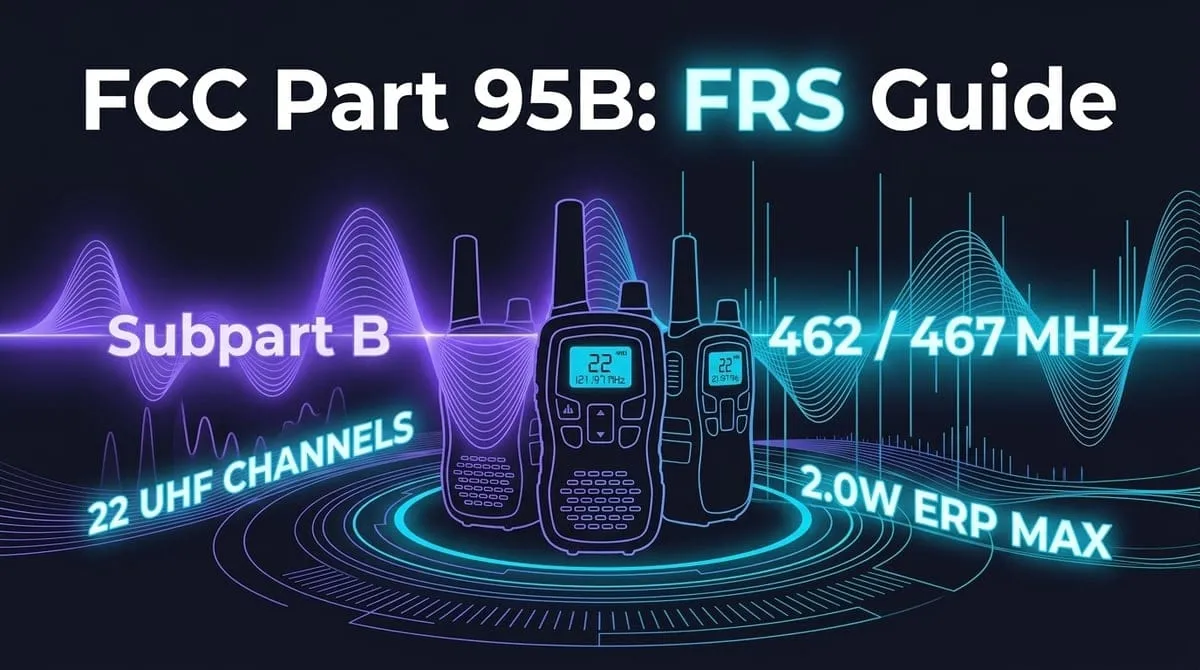
Walk into any sporting goods shop, hardware store, or big-box retailer, and you will find an entire shelf dedicated to blister-pack two-way radios. They promise “36-mile range,” advertise hundreds of “privacy codes,” and highlight hands-free communication for hiking, camping, and family vacations.
Almost all of those consumer radios are built for a specific slice of federal law: Title 47, Part 95, Subpart B of the Code of Federal Regulations (47 CFR Part 95 Subpart B), known officially as the Family Radio Service (FRS).
Because FRS requires no paperwork, tests, or licensing fees, it is easy to dismiss as a toy service where anything goes. In the field, however, FRS is a tightly regulated, channel-sharing land-mobile radio service. It operates across the exact same UHF frequencies as GMRS, relies on strict physical equipment boundaries, and provides legitimate short-range utility for families, trail groups, and commercial job sites alike.
This guide breaks down the regulatory, technical, and operating realities of Subpart B, separating blister-pack marketing claims from federal operating rules.
Primary Sources: Rules cited in this guide reflect current Title 47 Part 95 rules published in the eCFR, including the 2017 Part 95 Personal Radio Service Reform (FCC 17-57, 82 FR 41104), the 2021 data update (FCC 21-90), and the direct final certification cleanup order (FCC 25-77, 90 FR 57698, effective February 10, 2026).
01 · What FRS Actually Is (§ 95.503)
The FCC defines the Family Radio Service under 47 CFR § 95.503 as a short-distance two-way voice communication service with limited data applications, designed around low-power handheld radios for individual, family, group, recreational, and business activities.
That statutory definition immediately highlights four core principles:
- “Family” is just a name. The FCC does not require you to be related to the people you talk to on the radio. Friends, hiking groups, festival crews, and commercial businesses can all use FRS.
- Handheld portables only. FRS is strictly built around self-contained handheld transceivers. There is no legal provision for base stations, high-power mobile vehicle rigs, or external roof-mounted antennas.
- It is not strictly analog voice. While voice is the primary mission, the rules permit specific digital data bursts for GPS coordinates and short text messaging.
- The three-layer compliance test. Lawful operation requires satisfying three independent layers:
- Permission to operate (§ 95.305: eligible operators).
- Permission for message content (§ 95.531 / § 95.533: valid two-way speech, traveler assistance, emergency traffic, or approved data).
- Certified equipment (§ 95.335 / § 95.361 / § 95.561(c): a transmitter certified by the FCC specifically for Part 95 Subpart B).
If any of those three legs fail, you are operating outside federal authorization.
02 · Authorized by Rule vs. “License-Free” (§ 95.305)
Retail packages routinely brand FRS radios as “license-free.” In actual radio law, they are licensed by rule (or authorized by rule) under 47 CFR § 95.305.
That distinction carries practical legal teeth:
- You are operating a licensed federal radio station. You do not need to submit an application, pay a regulatory fee, or take an examination. But your station authorization exists solely because you obey the rules of Subpart A and Subpart B.
- Violate the equipment rules, lose the license. If you modify an FRS radio with an external antenna connector, feed it into a linear amplifier, or transmit with an uncertified radio tuned to FRS channels, you are no longer operating within the scope of your rule-based license. Under federal law, you are transmitting without a license on shared government airwaves.
- Who can operate: Any eligible person can pick up an FRS radio and transmit. There is no minimum age requirement. The only statutory exclusions under § 95.305 are representatives of foreign governments acting in an official capacity and individuals subject to an FCC cease-and-desist order.
- Business use is 100% legal: A warehouse manager, landscaping company, or film crew can purchase a dozen FRS radios and distribute them to unrelated employees for job-site coordination. Unlike GMRS, which restricts operations under an individual license to immediate family members, FRS authorizes anyone who picks up a compliant radio to use it for personal or business communications. The only commercial restriction is § 95.333: you cannot use FRS to provide a common-carrier message-for-hire service.
03 · Operating Boundaries: Where Can You Transmit? (§ 95.307, § 95.309)
Under 47 CFR § 95.307, an authorized FRS station can operate:
- Within the fifty United States and the District of Columbia.
- Across U.S. territories and possessions (Puerto Rico, U.S. Virgin Islands, Guam, American Samoa, and the Northern Mariana Islands).
- Aboard U.S.-registered vessels and aircraft, provided you have the explicit permission of the vessel captain or pilot in command (§ 95.307(b)).
Airlines & Foreign Borders: While § 95.307(b) allows aircraft operation with the captain’s permission, commercial airline passenger policies and FAA rules independently prohibit in-flight two-way radio transmissions. Additionally, an FCC Part 95 certification carries no legal authority outside the United States. Taking a U.S. FRS radio to Europe (where PMR446 governs personal radio) or Latin America can cause direct interference with foreign police, emergency, or business allocations.
Section 95.309 also establishes specific geographic areas where radio transmissions face additional coordination or restrictions, including the National Radio Quiet Zone around Green Bank, West Virginia, designated radio astronomy observatories, and sensitive international border corridors.
04 · Permitted Traffic, Attended VOX, and Prohibitions (§ 95.531, § 95.533)
What can you actually say and send over FRS airwaves?
Lawful Traffic
Under 47 CFR § 95.531, FRS stations may transmit:
- Two-way voice communications with other FRS stations.
- Direct two-way voice communications with GMRS stations operating on shared channels.
- Permitted one-way voice transmissions: emergency distress communications, traveler assistance, voice paging to call a specific party, and brief equipment tests.
- Certified digital data bursts: GPS location coordinates, location interrogation requests, and brief text messages targeted to specific units.
The Attended VOX Distinction
Hands-free Voice-Operated Transmission (VOX) is standard on many consumer FRS radios. Under 47 CFR § 95.343, an operator must be present at the control point and actively monitor transmissions.
When you wear a headset while hiking and your voice keys the radio, you remain the attended control operator. However, using VOX to set an FRS radio on a dresser as an unattended nursery monitor or continuous room-audio surveillance device directly violates § 95.533, which strictly forbids unauthorized continuous one-way transmissions.
Prohibited Operations
Under 47 CFR § 95.333 and § 95.533, you may never use FRS for:
- Intentional interference with another station.
- False or deceptive distress signals.
- Obscene, indecent, or profane words.
- Broadcasting music, radio programming, or commercial advertisements.
- Store-and-forward packet repeaters or automated telemetry systems.
05 · The 22 Channels & Power Ceilings (§ 95.563, § 95.567)
FRS operates across 22 channels divided into three distinct frequency groups:
| FRS Channel | Center Frequency (MHz) | Maximum Legal ERP | Band Position & Offset | GMRS Relationship |
|---|---|---|---|---|
| 1 | 462.5625 | 2.0 Watts | 462 MHz Interstitial (+12.5 kHz) | Shared with GMRS (5W ERP limit in GMRS) |
| 2 | 462.5875 | 2.0 Watts | 462 MHz Interstitial (+12.5 kHz) | Shared with GMRS (5W ERP limit in GMRS) |
| 3 | 462.6125 | 2.0 Watts | 462 MHz Interstitial (+12.5 kHz) | Shared with GMRS (5W ERP limit in GMRS) |
| 4 | 462.6375 | 2.0 Watts | 462 MHz Interstitial (+12.5 kHz) | Shared with GMRS (5W ERP limit in GMRS) |
| 5 | 462.6625 | 2.0 Watts | 462 MHz Interstitial (+12.5 kHz) | Shared with GMRS (5W ERP limit in GMRS) |
| 6 | 462.6875 | 2.0 Watts | 462 MHz Interstitial (+12.5 kHz) | Shared with GMRS (5W ERP limit in GMRS) |
| 7 | 462.7125 | 2.0 Watts | 462 MHz Interstitial (+12.5 kHz) | Shared with GMRS (5W ERP limit in GMRS) |
| 8 | 467.5625 | 0.5 Watts | 467 MHz Interstitial (+12.5 kHz) | Shared with GMRS (0.5W ERP handheld-only in GMRS) |
| 9 | 467.5875 | 0.5 Watts | 467 MHz Interstitial (+12.5 kHz) | Shared with GMRS (0.5W ERP handheld-only in GMRS) |
| 10 | 467.6125 | 0.5 Watts | 467 MHz Interstitial (+12.5 kHz) | Shared with GMRS (0.5W ERP handheld-only in GMRS) |
| 11 | 467.6375 | 0.5 Watts | 467 MHz Interstitial (+12.5 kHz) | Shared with GMRS (0.5W ERP handheld-only in GMRS) |
| 12 | 467.6625 | 0.5 Watts | 467 MHz Interstitial (+12.5 kHz) | Shared with GMRS (0.5W ERP handheld-only in GMRS) |
| 13 | 467.6875 | 0.5 Watts | 467 MHz Interstitial (+12.5 kHz) | Shared with GMRS (0.5W ERP handheld-only in GMRS) |
| 14 | 467.7125 | 0.5 Watts | 467 MHz Interstitial (+12.5 kHz) | Shared with GMRS (0.5W ERP handheld-only in GMRS) |
| 15 | 462.5500 | 2.0 Watts | 462 MHz Main Repeater Output 1 | Shared with GMRS (50W max output in GMRS) |
| 16 | 462.5750 | 2.0 Watts | 462 MHz Main Repeater Output 2 | Shared with GMRS (50W max output in GMRS) |
| 17 | 462.6000 | 2.0 Watts | 462 MHz Main Repeater Output 3 | Shared with GMRS (50W max output in GMRS) |
| 18 | 462.6250 | 2.0 Watts | 462 MHz Main Repeater Output 4 | Shared with GMRS (50W max output in GMRS) |
| 19 | 462.6500 | 2.0 Watts | 462 MHz Main Repeater Output 5 | Shared with GMRS (50W max output in GMRS) |
| 20 | 462.6750 | 2.0 Watts | 462 MHz Main Repeater Output 6 | Shared with GMRS (50W max output in GMRS) |
| 21 | 462.7000 | 2.0 Watts | 462 MHz Main Repeater Output 7 | Shared with GMRS (50W max output in GMRS) |
| 22 | 462.7250 | 2.0 Watts | 462 MHz Main Repeater Output 8 | Shared with GMRS (50W max output in GMRS) |
Frequency Geometry: How Interstitials Fit
To understand why FRS channels sit on unusual decimals, look at the UHF band plan. Interstitial channels sit exactly 12.5 kHz offset between the primary 25 kHz main channels:
462.5500 MHz (Main / GMRS Output 15) │ +12.5 kHz offset ▼462.5625 MHz (FRS Channel 1) │ +12.5 kHz offset ▼462.5750 MHz (Main / GMRS Output 16) │ +12.5 kHz offset ▼462.5875 MHz (FRS Channel 2)Consecutive interstitial channels (such as Channel 1 and Channel 2) sit 25 kHz apart, each tucked exactly halfway between neighboring main channels.
The Repeater Input Trap: Why FRS Cannot Key Repeaters
One of the most persistent myths among new operators is that FRS radios can work through GMRS repeaters on channels 15 through 22.
Here is the technical reality:
- GMRS repeaters listen on 467 MHz main input frequencies (467.5500 to 467.7250 MHz) and simultaneously retransmit on 462 MHz main output frequencies (462.5500 to 462.7250 MHz) using a +5.000 MHz offset.
- FRS radios do not possess the eight 467 MHz main repeater input frequencies.
- Channels 8 through 14 are interstitial frequencies (e.g., 467.5625 MHz), sitting 12.5 kHz off from the repeater inputs. Transmitting on Channel 8 sends RF on 467.5625 MHz—not on the 467.5500 MHz repeater input.
- When an FRS radio transmits on Channel 15, it transmits on 462.5500 MHz (the repeater’s output frequency).
An FRS operator standing near a repeater can hear users talking on channels 15 through 22. But when the FRS operator presses push-to-talk, the radio transmits on the output frequency, talking over the repeater to nearby radios while failing to key up the repeater machine.
06 · ERP, Antennas, and Range Realities (§ 95.587)
Power limits in FRS are expressed strictly in Effective Radiated Power (ERP) under 47 CFR § 95.567, not transmitter output power.
What ERP Means
ERP measures the actual effective signal radiated into the air, using a half-wave dipole antenna as the reference:
A radio with 2.0 Watts of RF generated by its internal circuit driving an antenna with negative gain (such as a shortened rubber ducky) might only radiate 1.2 Watts ERP into the air.
The 0.5 Watt vs. 2.0 Watt Difference
Moving from 0.5 Watts ERP (Channels 8–14) to 2.0 Watts ERP (Channels 1–7 and 15–22) represents a fourfold increase in power, which translates to a +6 dB gain:
In pure free-space physics where signals decay by the inverse-square law (), a 6 dB boost in power offsets the loss from doubling your communication distance.
In the real world, however, UHF radio waves do not travel through free space. They pass through pine needles, brush, hills, sheet metal, and building drywall. If a solid granite ridge blocks your line of sight, increasing power from 0.5 Watts to 2.0 Watts will not push the signal through the rock. Antenna elevation and clear line of sight dictate 90% of your real-world UHF performance.
The Non-Removable Antenna Rule
Under 47 CFR § 95.587(b), every FRS radio must feature an antenna that is a non-removable, integral part of the radio. The antenna cannot have more gain than a half-wave dipole (2.15 dBi) and must be vertically polarized during normal operation.
If a handheld has an SMA connector, a BNC jack, or allows you to unscrew the antenna, it is not an FRS radio. Connecting an external magnetic-mount roof antenna or attaching a high-gain whip fundamentally strips the unit of its Subpart B certification under § 95.337 and § 95.339.
07 · Technical Parameters: Modulation, Accuracy & Masks
FRS technical standards ensure clean operation without bleeding into adjacent channels:
| Parameter | FCC Part 95B Requirement | Rule Citation |
|---|---|---|
| Channel Bandwidth | 12.5 kHz | 47 CFR § 95.563 |
| Occupied Bandwidth | Maximum 12.5 kHz | 47 CFR § 95.573 |
| Permitted Emission Types | F3E, G3E (Voice) / F2D, G2D (Data) | 47 CFR § 95.571 |
| Peak Frequency Deviation | Maximum ±2.5 kHz | 47 CFR § 95.575 |
| Audio Low-Pass Filter | Capped at 3.125 kHz audio input | 47 CFR § 95.575 |
| Carrier Frequency Accuracy | Within ±2.5 ppm of center frequency | 47 CFR § 95.565 |
Carrier Drift Math
Under § 95.565, an FRS transmitter’s carrier frequency must remain within ±2.5 parts per million (ppm) of the assigned channel center across normal operating temperatures.
On Channel 1 (462.5625 MHz), that calculation yields:
The transmitter’s unmodulated carrier cannot drift more than approximately 1.15 kHz off frequency. That carrier tolerance prevents adjacent-channel bleeding into neighboring GMRS main frequencies just 12.5 kHz away.
CTCSS & DCS: Signaling vs. “Privacy”
Subaudible squelch tones are authorized under 47 CFR § 95.377:
- Subaudible tones (≤300 Hz), such as standard analog CTCSS tones (67.0 Hz to 250.3 Hz) and digital DCS codes, may transmit continuously throughout voice conversations (§ 95.377(b)).
- Audible signaling tones (>300 Hz) used for selective calling or unit alerts cannot transmit for more than 15 seconds at a time (§ 95.377(a)).
- End-of-transmission tones (“Roger Beeps”) are permitted under § 95.577, provided they do not exceed 225 milliseconds.
“Privacy Codes” Do Not Encrypt: Turning on CTCSS tone 121 (or “Privacy Code 1”) does not hide your voice or secure your conversation. It simply tells your radio’s speaker to stay muted unless a signal carrying that exact sub-audible tone is received. Anyone monitoring in open-carrier mode can hear every word you say. Furthermore, if two groups transmit on the same channel simultaneously with different codes, the signals collide and garble each other.
Emission Mask Attenuation (§ 95.579)
Transmitters must sharply attenuate unwanted emissions outside the authorized channel to prevent interference:
- 6.25 kHz to 12.5 kHz displacement: Attenuated by at least 25 dB.
- 12.5 kHz to 31.25 kHz displacement: Attenuated by at least 35 dB.
- Beyond 31.25 kHz displacement: Attenuated by at least (where is carrier power in Watts).
08 · Digital Data Timing and Automation (§ 95.587, FCC 21-90)
Many users are surprised to learn that FRS supports digital data. Popularized by outdoor GPS radios like the Garmin Rino series, digital features allow hikers and hunters to transmit coordinates and text messages directly over the radio.
Under 47 CFR § 95.587(c)–(d), digital emissions must obey rigid timing caps:
- 1-Second Burst Limit: Any digital packet transmission cannot exceed a continuous duration of one second.
- 30-Second Minimum Interval: A radio cannot initiate an automated digital transmission more frequently than once every 30 seconds. A repeating 1-second burst every 30 seconds caps the digital airtime duty cycle at roughly 3.3%.
- The Interrogation Exception: Under § 95.587(c)(2), a radio may transmit an automatic location reply more frequently than once every 30 seconds if it is responding to a direct interrogation poll received from another specific FRS or GMRS station.
- Specific Addressing Required: Digital text messages must be addressed to specific individual units or targeted groups. General, unaddressed digital data broadcasts are prohibited.
- No Packet Repeaters: Devices that capture, store, and retransmit digital packets to extend range are explicitly barred.
09 · Talking to GMRS: The FM Deviation Audio Mismatch
Because FRS and GMRS share all 22 frequencies, cross-service communication is fully lawful under 47 CFR § 95.531(c). A family using blister-pack FRS radios around a campsite can talk directly to a licensed GMRS base station or mobile vehicle rig.
However, cross-service operation frequently runs into an annoying audio problem: the FM bandwidth mismatch.
Transmitting GMRS (Wide FM / ±5 kHz Dev)  ──>  Receiving FRS (Narrow Filter / ±2.5 kHz)Result: Audio clips, sounds excessively loud, and distorts the receiver.
Transmitting FRS (Narrow FM / ±2.5 kHz Dev) ──>  Receiving GMRS (Wide Filter / ±5 kHz)Result: Audio sounds low, quiet, and thin, forcing the GMRS user to crank the volume.
Why This Happens
- FRS is locked to Narrowband FM: FRS rules mandate a 12.5 kHz occupied bandwidth ceiling and a maximum peak deviation of ±2.5 kHz.
- GMRS allows Wideband FM on 462 MHz: On channels 1–7 and 15–22, GMRS stations are legally permitted to run Wideband FM with an occupied bandwidth of up to 20 kHz and peak deviation of ±5.0 kHz (§ 95.1773, § 95.1775).
When a wideband GMRS signal hits an FRS radio’s narrow ceramic IF filter, the wide audio swings exceed the receiver’s demodulator window, resulting in harsh, clipped, and distorted audio. Conversely, when a narrow FRS signal hits a wide GMRS receiver, the smaller deviation occupies only half the expected bandwidth, making the audio faint and quiet.
Set GMRS Radios to “Narrow” When Talking to FRS: If you operate a GMRS radio and communicate with friends or family on FRS handhelds, switch your GMRS radio’s bandwidth menu setting from Wide (25 kHz) to Narrow (12.5 kHz) on channels 1–7 and 15–22. This matches your transmit deviation and receiver filtering to the FRS radios, restoring clean, balanced audio in both directions.
(Note: On Channels 8 through 14, GMRS rules already mandate the exact same ±2.5 kHz deviation and 12.5 kHz bandwidth limits as FRS, so no manual adjustment is needed there.)
10 · Regulatory History & The Bubble-Pack Reclassification
To understand modern FRS equipment, you have to look at how the FCC restructured Part 95 over the past three decades:
- 1996 (Birth of FRS): The FCC established the Family Radio Service in Report and Order FCC 96-215 (61 FR 28766) to give the public a simple, license-free UHF alternative to crowded CB and complicated commercial business bands. Originally, FRS was confined to channels 1–14 with a maximum power of 0.5 Watts ERP.
- 2003 (Digital Location Data): In response to a petition from Garmin International, the FCC adopted FCC 03-26 (68 FR 9900), authorizing GPS position bursts and short text messages using
F2Demission. - 2017 (The Part 95 Overhaul — FCC 17-57): By the mid-2010s, retailers were flooding store shelves with hybrid “FRS/GMRS” combination radios. Consumers routinely bought blister packs, switched to channels 15–22 or high power, and transmitted without knowing they were breaking federal licensing laws. In Report and Order FCC 17-57 (82 FR 41104), the Commission completely overhauled Part 95:
- Bumped FRS power on Channels 1–7 from 0.5 W to 2.0 W ERP.
- Added Channels 15–22 to FRS at 2.0 W ERP.
- Retained Channels 8–14 strictly for 0.5 W handheld portables.
- Prohibited future certification of dual-service combo radios under § 95.561(c).
- 2021 (Automated Data Updates): In FCC 21-90, the FCC authorized automatic, periodic initiation of GPS position reports while maintaining the 30-second interval limit.
- 2025/2026 (Certification Cleanup — FCC 25-77): The FCC issued direct final rule FCC 25-77 (90 FR 57698, effective February 10, 2026), removing redundant certification text in § 95.561(a)–(b) while explicitly preserving § 95.561(c) to keep the prohibition on combo handheld radios active.
The Great Pre-2017 Radio Reclassification
What happened to the millions of old “FRS/GMRS” bubble-pack radios sold before December 27, 2017? In FCC 17-57 (paragraphs 51–53), the FCC drew a clean line:
- Reclassified as FRS: If a legacy combination radio operates at 2.0 Watts ERP or less on channels 1–7 and 15–22, 0.5 Watts or less on channels 8–14, and cannot transmit on 467 MHz repeater inputs, it was automatically reclassified as an FRS radio. It can be operated license-by-rule today without an individual FCC license.
- Reclassified as GMRS: If a legacy radio exceeded 2.0 Watts ERP, had a removable antenna, or possessed the capability to transmit on 467 MHz repeater inputs, it was reclassified as a GMRS station. Operating it requires an individual GMRS station license.
11 · Practical Field Scenarios
Here is how Subpart B rules apply to real-world operating scenarios:
Scenario A: A Retail Store Equips Staff With Handhelds
A store manager buys ten blister-pack FRS radios to coordinate floor staff.
- Verdict: Fully lawful. Section 95.503 explicitly covers business activities, and § 95.305 authorizes employees to transmit without personal licenses.
Scenario B: An Off-Road Convoy Uses Channel 20
A group of 4x4 drivers uses Channel 20 (462.675 MHz) with stock FRS radios.
- Verdict: Fully lawful. Since the 2017 overhaul, Channels 15 through 22 are fully authorized for FRS at up to 2.0 Watts ERP.
Scenario C: Adding an SMA Magnetic Mount Roof Antenna
An operator solders an SMA jack onto an FRS radio to plug into a vehicle roof antenna for better trail range.
- Verdict: Unlawful. Violates § 95.587(b) (non-removable integral antenna mandate), § 95.337 (unauthorized equipment modification), and § 95.339 (adding external accessories that violate rules). The unit loses its certification.
Scenario D: Programming a Commercial Part 90 Radio to FRS
An operator buys an unlocked commercial radio, programs the 22 FRS frequencies, sets output power to 1 Watt, and transmits.
- Verdict: Unlawful. Under 47 CFR § 95.335, transmitters operated in FRS must hold a specific Part 95 Subpart B equipment grant. Setting a non-certified radio to low power does not create legal operating authority.
12 · Field Operator Checklist
To keep your FRS operations clean, effective, and compliant:
- Check the Label: Ensure your radio carries an authentic FCC Part 95 Subpart B certification.
- Keep the Stock Antenna: Never attempt to unscrew, extend, or modify the factory-molded antenna.
- Use Channels 1–7 or 15–22 for Distance: When working near maximum handheld range, choose Channels 1–7 or 15–22 to utilize the full 2.0 Watts ERP rather than the 0.5 Watts limit on Channels 8–14.
- Switch GMRS Partners to Narrow FM: When cross-communicating with GMRS stations on channels 1–7 or 15–22, have the GMRS operator set their bandwidth to Narrow to eliminate distorted, clipped audio.
- Attend Hands-Free VOX: If using VOX headsets, stay at the controls; never leave an FRS radio unattended as a continuous open microphone.
- Remember That Codes Aren’t Scramblers: Never transmit private financial, medical, or security details over FRS—“privacy codes” do not encrypt your signal.
- Listen Before Keying Up: FRS channels are shared public resources. Pause, listen for ongoing conversations, and yield courteously to other operators.