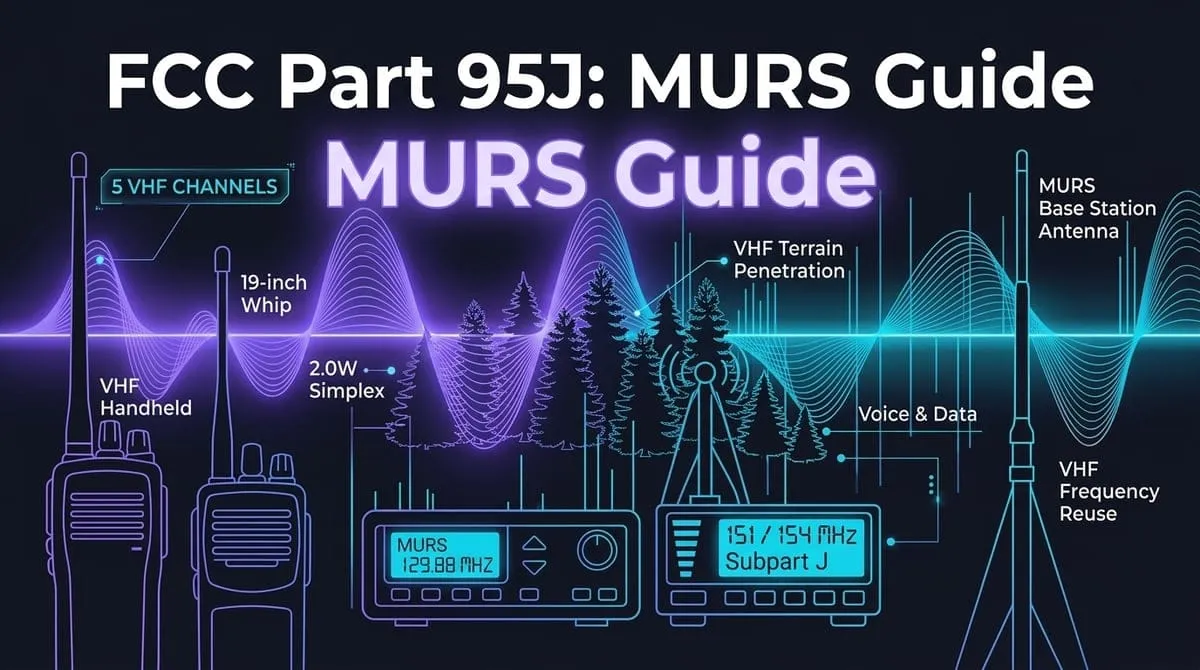
When operators look for license-free two-way radio options, the conversation usually stops at FRS or CB. FRS provides easy, blister-pack convenience on UHF, but traps you behind permanently attached antennas and low power limits. CB gives you external antennas and high-power sideband on HF, but requires massive 9-foot mobile whips and battles noisy atmospheric skip.
Tucked between them lies one of the most capable, underutilized personal radio bands in the United States: Title 47, Part 95, Subpart J of the Code of Federal Regulations (47 CFR Part 95 Subpart J), known as the Multi-Use Radio Service (MURS).
Created in 2000 from legacy industrial business frequencies, MURS operates in the Very High Frequency (VHF) band around 151 MHz and 154 MHz. It combines license-free operation with detachable external antennas, commercial-grade business utility, digital telemetry, and VHF propagation that bends over rolling hills and cuts through heavy forest timber where UHF signals struggle.
However, MURS operates under strict federal boundaries: a rigid 2-watt transmitter power ceiling, specific channel-by-channel bandwidth restrictions, and a zero-tolerance ban on repeaters and store-and-forward digipeaters.
This guide breaks down the engineering, regulatory, and field operating rules of MURS, separating VHF folklore from federal law.
Primary Sources: Citations reflect current Title 47 Part 95 rules published in the eCFR, including the 2000 MURS establishment order (PR Docket 92-235, FCC 00-211, 65 FR 60869), the 2002 transition memorandum order (FCC 02-139 / DA 02-2256, 67 FR 63279), and the direct final certification cleanup order (FCC 25-77, 90 FR 57698, effective February 10, 2026).
01 · What MURS Actually Is (§ 95.2703)
Under 47 CFR § 95.2703, the FCC defines MURS as a short-distance, two-way voice or data communication service for personal or business activities of the general public.
MURS is built on five specific VHF assignments. Because it operates on VHF (wavelengths around 2 meters / 6.5 feet), signals propagate very differently than UHF (GMRS/FRS at 70 cm) or HF (CB at 11 meters). VHF waves diffract more effectively around terrain, bend over hilltops, and suffer significantly less absorption from dense foliage and pine needles.
To see how MURS compares to other Part 95 services, look at the technical breakdown:
| Operational Feature | MURS (Subpart J) | FRS (Subpart B) | GMRS (Subpart E) | CB (Subpart D) |
|---|---|---|---|---|
| Authorization Model | Authorized by Rule (§ 95.305) | Authorized by Rule (§ 95.305) | Individual License (§ 95.1705) | Authorized by Rule (§ 95.305) |
| RF Spectrum | 151 / 154 MHz VHF | 462 / 467 MHz UHF | 462 / 467 MHz UHF | 26.965–27.405 MHz HF |
| Channel Pool | 5 VHF Frequencies | 22 UHF Channels | 30 Frequencies (22 Simplex + 8 Repeater Inputs) | 40 HF Channels |
| Power Measurement | 2.0 W Transmitter Output | 0.5 W to 2.0 W ERP | Up to 50 W Output / 5 W ERP | 4 W Carrier (AM/FM) / 12 W PEP (SSB) |
| External Antennas | Permitted (Up to 60 ft AGL or 20 ft above structure) | Prohibited (Fixed integral only) | Permitted (Base & Mobile) | Permitted (Base & Mobile) |
| Repeater Operation | Strictly Prohibited (No store-and-forward) | Prohibited | Permitted (Duplex pairs) | No Duplex Repeaters |
| Permitted Data | Voice, Data, Images, Telemetry, Telecommand | Limited location/text bursts | Limited location/text bursts | Voice centered |
02 · Authorized by Rule & Commercial Utility (§ 95.305, § 95.2703)
Like FRS and CB, MURS does not require an individual FCC license application, examination, or regulatory fee. Under 47 CFR § 95.305, operators are authorized by rule.
That statutory authorization establishes clear operating conditions:
- Universal Eligibility: Anyone who is not a representative of a foreign government and not under an FCC cease-and-desist order can operate a MURS station.
- No Family-Only Restriction: Unlike GMRS—which limits station operation to immediate family members under an individual license—MURS has zero family restrictions. A business owner can buy twenty certified MURS radios and hand them to warehouse workers, forklift drivers, retail clerks, or security guards without individual paperwork.
- Tactical Handles & Station Identification: The FCC does not assign call signs for MURS stations. Operators are not required to transmit an official call sign every 15 minutes. In the field, tactical call signs (such as “Base to Unit 4” or “Security to Front Gate”) provide practical communication management without regulatory red tape.
- Compliance Voids Authorization: Operating an uncertified radio, running an illegal power amplifier, or transmitting on unauthorized frequencies automatically voids your authority under § 95.305. At that point, you are transmitting as an unlicensed station under federal law.
03 · Geographic Scope & Aircraft Prohibition (§ 95.307, § 95.2707)
Under 47 CFR § 95.307, MURS stations are authorized to operate anywhere within the fifty United States, the District of Columbia, and U.S. territories and possessions.
The Absolute Aircraft Ban (§ 95.2707)
One rule in Subpart J is uncompromising: MURS operation is strictly prohibited aboard aircraft in flight.
Section 95.2707 establishes that you cannot transmit from an airplane, helicopter, drone, glider, or hot-air balloon while airborne. This restriction applies equally to voice radios, automated GPS tracking beacons, and remote telemetry transmitters. The rule exists because elevated VHF transmissions travel hundreds of miles across the horizon, causing massive multi-state interference to land-based commercial and personal users.
International Travel Boundaries
If you travel outside the United States, leave your MURS radios turned off:
- Canada: Canada’s ISED does not recognize MURS. The frequencies around 151 and 154 MHz remain allocated to commercial, industrial, and public safety users in Canada.
- Mexico: Mexico does not allocate MURS spectrum for unlicensed personal radio use. Transmitting on MURS frequencies in Mexico is illegal.
04 · Permitted Signals: Voice, Data, Telemetry & Images (§ 95.2731)
One of the standout advantages of MURS is its broad operational scope under 47 CFR § 95.2731. While FRS and GMRS restrict digital transmissions to 1-second location bursts on dedicated handhelds, MURS permits a comprehensive array of operational modes:
| Communication Mode | Authorized Operational Application | Field Implementation Rules |
|---|---|---|
| Voice Communications | Direct two-way speech for personal, family, or business logistics. | Simplex push-to-talk. Compatible narrowband or wideband audio. |
| Digital Data | Exchanging digitally encoded information between endpoints. | Must fit channel bandwidth ceilings; standard audio subcarriers (AFSK). |
| Image Transmissions | Still image transfers, weather cam snapshots, and telemetry diagrams. | Slow-scan or packet transfers; broad video streaming is bandwidth-prohibited. |
| Telemetry | Automated reporting of environmental conditions, tank levels, security gates, and driveway sensors. | Must operate with discrete bursts, listen-before-talk carrier sensing, and no continuous carriers. |
| Telecommand | Sending remote control commands to mechanical equipment, pumps, sirens, or perimeter gates. | Commanding external equipment differs from remote control of the radio station itself. |
Unlike FRS and GMRS, MURS does not impose a mandatory 1-second burst or 30-second interval limit on digital transmissions. However, automated telemetry must share the channel responsibly. Transmitters cannot hog spectrum or hold a carrier open continuously.
05 · Channel Sharing & The Continuous Carrier Ban (§ 95.2725, § 95.2757)
All five MURS frequencies are shared equally among all users. No person, business, or security team can claim exclusive ownership of a channel.
Under 47 CFR § 95.2725, every operator must take reasonable precautions to avoid harmful interference:
- Monitor Before Transmitting: You must listen to the channel before transmitting to ensure you do not stomp on an ongoing conversation or automated telemetry signal.
- CTCSS/DCS Does Not Reserve Spectrum: Sub-audible privacy tones (CTCSS) and digital codes (DCS) only filter what opens your radio speaker. They do not make the channel private. If another station is transmitting without a tone, transmitting over them will cause destructive co-channel interference.
- No Continuous Carrier (§ 95.2757): Holding down push-to-talk indefinitely, broadcasting dead air, or leaving an open carrier keyed is explicitly banned. Transmissions must cease as soon as the message is delivered.
- General Part 95 Bans (§ 95.333): MURS stations cannot broadcast music, sound effects, commercial advertising, or intentional jamming.
06 · The Five VHF Channels & “Color Dot” Heritage (§ 95.2763)
Under 47 CFR § 95.2763, MURS provides five specific carrier frequencies. The channel numbering below reflects standard industry practice:
| Channel Slot | Center Frequency | Historical Dot Label | Maximum Output Power | Occupied Bandwidth Ceiling | Standard FM Profile |
|---|---|---|---|---|---|
| Channel 1 | 151.820 MHz | — | 2.0 Watts | 11.25 kHz | Narrowband FM (11K2F3E) |
| Channel 2 | 151.880 MHz | — | 2.0 Watts | 11.25 kHz | Narrowband FM (11K2F3E) |
| Channel 3 | 151.940 MHz | — | 2.0 Watts | 11.25 kHz | Narrowband FM (11K2F3E) |
| Channel 4 | 154.570 MHz | Blue Dot | 2.0 Watts | 20.0 kHz | Wideband FM (20K0F3E) / Narrow |
| Channel 5 | 154.600 MHz | Green Dot | 2.0 Watts | 20.0 kHz | Wideband FM (20K0F3E) / Narrow |
*Note: Amplitude modulated (A3E) emissions carry an absolute 8.0 kHz bandwidth ceiling across all five channels under § 95.2773.
Understanding the “Color Dot” Legacy
Before MURS was established in 2000, 154.570 MHz and 154.600 MHz were two of the most heavily used commercial channels in the Part 90 Business Radio Service. Business radios from Motorola, Ritron, and Standard Horizon were sold with color-coded stickers on the chassis:
- Blue Dot indicated 154.570 MHz.
- Green Dot indicated 154.600 MHz.
When the FCC created MURS under FCC 00-211 (PR Docket 92-235), it transitioned Blue Dot and Green Dot into Subpart J and added three new 151 MHz frequencies. Today, millions of older business walkie-talkies, department store call boxes, and drive-through communications still operate on Blue Dot and Green Dot.
The Bandwidth Divide: 11.25 kHz vs. 20.0 kHz
Notice the sharp bandwidth difference in the table above:
- Channels 1, 2, and 3 (151 MHz): Capped at a tight 11.25 kHz occupied bandwidth. You must configure your radio to Narrowband FM ( deviation). Running Wideband FM on these channels produces illegal adjacent-channel splatter.
- Channels 4 and 5 (154 MHz): Authorized for up to 20.0 kHz occupied bandwidth, allowing traditional Wideband FM ( deviation), though compatible narrowband operation is also legal.
Why are the 151 MHz channels restricted to 11.25 kHz? In the broader Part 90 VHF land-mobile band, other commercial business and industrial stations operate on interleaved assignments just 7.5 kHz away (such as 151.8125 MHz and 151.8275 MHz). The tight 11.25 kHz bandwidth ceiling and steep emission masks in § 95.2779 ensure MURS stations do not spill RF energy into neighboring commercial systems.
07 · Power Limits: Transmitter Output vs. ERP (§ 95.2767)
Under 47 CFR § 95.2767, the legal power limit for MURS is 2.0 Watts at the transmitter output (conducted power).
This is a critical distinction from services like FRS. In FRS, the FCC imposes an Effective Radiated Power (ERP) ceiling, which factors in antenna gain and restricts you to permanently attached antennas.
In MURS, the rule governs transmitter power output:
- Connecting an external high-gain antenna does not violate the 2-watt rule, provided the radio’s native transmitter stage outputs 2.0 watts or less.
- Attaching an external RF power amplifier to boost transmitter output to 25 or 50 watts is illegal under § 95.339.
Calculating Effective Radiated Power with High-Gain Antennas
Because MURS permits external antennas, operators can achieve remarkable range improvements along the horizon through antenna gain:
Consider a practical field comparison between a stock handheld and an elevated base station antenna:
- Stock Handheld Radio: A typical 2W VHF handheld with a 6-inch rubber duck antenna suffers negative gain due to physical shortening (roughly net gain). Effective radiated power along the horizon is only 1.26 Watts ERP.
- Elevated Base Station Collinear: If you connect that same 2W transmitter to a () omnidirectional collinear antenna via 50 feet of low-loss coax ( attenuation):
Your transmitter remains 100% legal at 2.0 watts conducted output, while your station radiates over 6.3 watts of effective signal along the horizon—multiplying your line-of-sight reach across valleys and ridges.
08 · Antenna Height Rules: Ground vs. Structure (§ 95.2741)
When erecting a base station antenna for MURS, how high can you legally go?
Under 47 CFR § 95.2741, the antenna height ceiling is governed by a dual-standard rule:
The highest point of any MURS antenna must not exceed 18.3 meters (60 feet) above the ground, or 6.10 meters (20 feet) above the highest point of the structure on which it is mounted, whichever is higher.
This structure-based alternative offers tremendous installation flexibility:
| Installation Site | Ground Height Ceiling | Structure Height Allowance | Maximum Legal Antenna Tip Elevation |
|---|---|---|---|
| Ground Mast (Open Yard) | 60 feet (18.3 m) above ground | N/A | 60 feet above ground level |
| Residential House (25 ft Ridge) | 60 feet (18.3 m) above ground | 20 ft above roof peak (45 ft AGL) | 60 feet above ground level (60 ft rule is higher) |
| Commercial Building (50 ft Roof) | 60 feet (18.3 m) above ground | 20 ft above roof structure (70 ft AGL) | 70 feet above ground level (Structure rule is higher) |
| Agricultural Silo (90 ft Peak) | 60 feet (18.3 m) above ground | 20 ft above silo peak (110 ft AGL) | 110 feet above ground level (Structure rule is higher) |
Trees vs. Structures: A Subtle Regulatory Detail
Operators familiar with CB rules know that 47 CFR § 95.941 explicitly permits mounting antennas up to 20 feet above a “building or tree”.
In MURS text under § 95.2741, the statute states “supporting structure”, without explicitly naming trees. While mounting an antenna in a tree is common on remote homesteads, operators should ensure the installation complies with general aviation clearance rules under § 95.317 and FAA Part 17 if located near an airport.
09 · Emissions, Deviation & Frequency Stability (§ 95.2765, § 95.2771)
Under 47 CFR § 95.2771, MURS transceivers are authorized for nine distinct emission classifications, including:
- F3E / G3E: Frequency or phase modulated analog voice.
- F1D / F2D: Frequency modulated digital data, telemetry, and telecommand.
- A1D / A2D / A3E: Amplitude modulated telegraphy, data, and double-sideband telephony.
Frequency Tolerance & Stability (§ 95.2765)
The carrier stability requirements for MURS differ markedly from GMRS:
| Emission Bandwidth Threshold | Required Carrier Tolerance (§ 95.2765) | Allowable Drift at 151.820 MHz | Allowable Drift at 154.600 MHz |
|---|---|---|---|
| 6.25 kHz or Less | |||
| Greater than 6.25 kHz |
Notice that the dividing line in MURS is 6.25 kHz, unlike GMRS which divides at 12.5 kHz. Standard analog narrowband voice (which occupies roughly 11.25 kHz) falls into the tolerance category.
Audio Filtering Clarification (§ 95.2775)
In some online forums, operators cite § 95.2775 as the rule establishing peak frequency deviation ( vs ).
That is a statutory misattribution. 47 CFR § 95.2775 is an audio low-pass filter specification. It mandates that an audio filter be placed between the transmitter’s modulation limiter and the modulated stage to roll off audio frequencies above 3.0 kHz. Peak frequency deviation is governed by authorized occupied bandwidth ceilings under § 95.2773 and the stringent emission masks in § 95.2779.
10 · Practical Tone Squelch & Audio Troubleshooting
Like FRS and GMRS, MURS radios support Continuous Tone-Coded Squelch System (CTCSS) and Digitally Coded Squelch (DCS).
To prevent common field communication breakdowns, follow these rules:
- Wide vs. Narrow Audio Mismatches:
- If a radio transmitting Wideband FM on Blue Dot (154.570 MHz) talks to a receiver locked on Narrowband FM, the receiver will distort, clip, and sound harsh when spoken into loudly.
- If a radio transmitting Narrowband FM talks to a Wideband receiver, the received speech will sound quiet and faint.
- Rule: For Channels 1–3, always set radios to NARROW. For Channels 4–5, agree in advance whether your team is running WIDE or NARROW.
- The “Silent Radio” Squelch Trap:
- If two radios are tuned to Channel 1 (151.820 MHz) but Radio A has CTCSS Tone 67.0 Hz enabled while Radio B has no tone (carrier squelch), Radio B will hear Radio A perfectly, but Radio A will remain completely silent when Radio B transmits.
- Rule: When setting up field radios, turn receive tones OFF (carrier squelch) first to verify mutual communication before enabling privacy tones.
11 · Data, Telemetry & 1200-Baud AFSK Modems (§ 95.2731)
Because MURS allows data, telemetry, and telecommand without restrictive duty-cycle timers, it is widely used for:
- Remote security driveway alarms (e.g., Dakota Alert systems).
- Off-grid water tank level sensors and solar battery telemetry.
- Automated gate openers and agricultural pump controllers.
- 1200-baud packet telemetry links.
Audio Frequency Shift Keying (F2D)
When sending digital data across an analog FM transceiver, the most common standard is Bell 202 Audio Frequency Shift Keying (AFSK). This system modulates audio between two tones:
- Mark: 1200 Hz
- Space: 2200 Hz
- Data Rate: 1200 baud
Under FCC rules (47 CFR § 2.201), feeding audio tones from an external modem into an FM transmitter creates an F2D emission.
Applying Carson’s Rule for necessary bandwidth:
With peak deviation and maximum audio frequency :
An occupied bandwidth of fits cleanly within the 11.25 kHz bandwidth ceiling of Channels 1 through 3, and easily within the 20 kHz ceiling of Channels 4 and 5.
Engineering Rules for Automated Telemetry
If you deploy automated sensors or microcontrollers on MURS, design your protocol to share spectrum responsibly:
- Carrier Sensing (Listen Before Talk): Ensure your modem checks for an open channel before keying the transmitter.
- Short Bursts: Transmit telemetry in bursts of 200 to 500 milliseconds.
- Randomized Backoff: If a collision occurs, implement randomized exponential backoff rather than hammering the channel at fixed intervals.
- Watchdog Timer: Include an automated PTT timeout circuit to cut power if a microcontroller locks up with the transmitter keyed.
12 · The Strict Ban on Repeaters & Digipeaters (§ 95.2733, § 95.2749)
While MURS allows external antennas and digital data, federal regulations draw an absolute line against network forwarding:
Under 47 CFR § 95.2733:
MURS stations must not be connected to a repeater station, signal booster station, or store-and-forward packet radio relay system.
This rule eliminates three common operating setups:
- No Duplex Repeaters: MURS has no paired repeater inputs or duplex repeater channels. You cannot set up a mountaintop relay to retransmit voice on another frequency.
- No Store-and-Forward Digipeaters: You cannot set up a digital packet radio (such as an APRS digipeater) that receives a data burst on 151.820 MHz, buffers it in memory, and retransmits it to extend network reach. Relaying data packets through an intermediary station is a direct violation of § 95.2733.
- No Public Telephone Patches (§ 95.2749): MURS stations cannot be interconnected with the public switched telephone network (PSTN) for phone calls.
All communications on MURS must be direct endpoint-to-endpoint simplex.
13 · Equipment Certification & Part 90 Realities (§ 95.335, § 95.2761)
Can you take an old commercial VHF radio or a dual-band ham radio and use it on MURS?
Federal law sets clear requirements:
- Mandatory Part 95J Certification: Every transmitter operated on MURS must be certified under 47 CFR Part 95, Subpart J (§ 95.335).
- The Multi-Service Ban (§ 95.2761(c)): The FCC explicitly bars certifying transmitters capable of operating under MURS and any other non-Part 15 radio service. A radio cannot be certified for both MURS and Amateur Radio, or both MURS and GMRS.
- Unlocked Ham Radios Are Illegal: Using an amateur radio transceiver (such as a Baofeng UV-5R or Yaesu FT-60R) with an unlocked transmitter to operate on MURS is a federal violation under 47 CFR § 95.337.
- The 2025/2026 Direct Final Rule Cleanup (FCC 25-77): The FCC’s recent cleanup order removed redundant text in § 95.2761(a)–(b), directing operators to general certification rules in § 95.361. Notably, the Commission retained § 95.2761(c), preserving the strict multi-service certification ban.
Grandfathered Part 90 Radios & Historical Cutoffs
There is one major exception to the certification rule for older commercial radios:
- Under former 47 CFR § 95.603(g)—established by FCC 02-139 (67 FR 63279)—transmitters that were already certified under Part 90 on MURS frequencies prior to November 12, 2002 are legally grandfathered for MURS operation without recertification.
- Under 47 CFR § 95.2705, commercial stations holding valid Part 90 licenses on MURS frequencies as of November 13, 2000 may continue operating under their original license conditions.
If you own a legacy commercial VHF radio (such as an older Motorola Radius or Kenwood commercial rig) that received its Part 90 certification grant before November 12, 2002, and it is programmed to transmit at 2.0 watts output or less within MURS bandwidth limits, it is grandfathered for lawful operation.
14 · VHF vs. UHF: How MURS Performs Outdoors
Why choose MURS over GMRS or FRS? The answer comes down to VHF electromagnetic propagation:
VHF (151 MHz — MURS) UHF (462 MHz — GMRS/FRS)Wavelength: ~2 meters (6.5 ft) Wavelength: ~0.65 meters (2.1 ft)┌────────────────────────────┐ ┌────────────────────────────┐│ • Bends over ridges/hills │ │ • Bounces in urban canyons ││ • Penetrates heavy forests │ │ • Penetrates tinted glass ││ • Lower foliage absorption │ │ • Compact handheld antennas││ • Requires larger antennas │ │ • Suffers foliage scatter │└────────────────────────────┘ └────────────────────────────┘In dense outdoor terrain—such as hunting in thick coniferous forests, navigating rolling farm pastures, or coordinating search teams in mountainous foothills—MURS frequently outperforms 4-watt UHF handhelds.
VHF waves experience significantly less absorption by green tree canopies and pine needles. While a 462 MHz UHF signal scatters against dense timber, a 151 MHz VHF wave diffracts around tree trunks and conforms more smoothly over rolling topography.
Conversely, UHF performs better inside modern industrial plants, office buildings, and densely built shopping malls, where shorter wavelengths bounce cleanly through metal corridors and interior drywall.
15 · Practical Field Checklist & Scenarios
To get the most out of MURS while staying compliant, keep these real-world scenarios and rules in mind:
Scenario 1: Setting Up Warehouse Logistics
- The Situation: A distribution center needs to equip thirty warehouse pickers, pack workers, and loading dock drivers with two-way radios.
- The Solution: MURS is ideal. Buy thirty certified MURS handhelds. No FCC license application is needed, and unrelated employees are fully authorized to operate under § 95.305. Tune them to Channel 4 (154.570 MHz) with a matching CTCSS tone to filter out neighboring traffic.
Scenario 2: Splatter on Channel 2
- The Situation: You are communicating on Channel 2 (151.880 MHz), but nearby commercial users complain of static and audio splatter.
- The Diagnosis: Your radio’s menu is set to Wideband FM (20 kHz). On Channels 1–3, the legal bandwidth limit is 11.25 kHz.
- The Fix: Switch the radio menu setting to NARROW. This drops peak deviation to , pulling your signal inside the 11.25 kHz envelope and eliminating adjacent-channel interference.
Scenario 3: Installing an Off-Grid Homestead Base Station
- The Situation: You want to coordinate between a homestead ranch house and mobile farm trucks working five miles away behind timbered ridges.
- The Solution: Mount a high-gain VHF vertical antenna (such as a 6 dBd fiberglass collinear) 20 feet above your two-story ranch roof (roughly 50 feet total above ground). Connect it to a 2W certified MURS base station using low-loss LMR-400 coax. The combination of VHF terrain diffraction, high mast elevation, and antenna gain will bridge the 5-mile timbered gap cleanly at legal power.
Pre-Transmission Operator Checklist
- Equipment Verification: Ensure radio has a valid Part 95J FCC ID grant (or grandfathered pre-Nov 2002 Part 90 grant).
- Bandwidth Setting: Set to NARROW on Channels 1, 2, and 3 (151 MHz); choose Narrow or Wide on Channels 4 and 5 (154 MHz).
- Channel Monitoring: Listen before keying push-to-talk to avoid interrupting existing communications.
- Power Check: Verify transmitter output is at or below 2.0 Watts conducted power; ensure no external amplifiers are connected.
- Antenna Siting: Keep base antenna tip within 60 feet of ground or within 20 feet of the roof structure peak.
- No Relays: Ensure all communications are direct simplex; disable any store-and-forward packet repeaters or cross-band links.
Reference Links & Primary Authorities
- FCC eCFR Title 47 Part 95 Subpart J: eCFR — 47 CFR Part 95 Subpart J (MURS)
- FCC MURS Establishment Order (FCC 00-211): PR Docket 92-235 Biennial Regulatory Review (65 FR 60869)
- FCC Transition & Clarification Order (FCC 02-139): FCC 02-139 / DA 02-2256 (67 FR 63279)
- FCC Direct Final Cleanup Order (FCC 25-77): FCC 25-77 Report & Order (PDF)
- Companion Guides: FCC Part 95 Personal Radio Services Guide · Subpart B: FRS Deep Dive · Subpart D: CB Deep Dive · Subpart E: GMRS Deep Dive