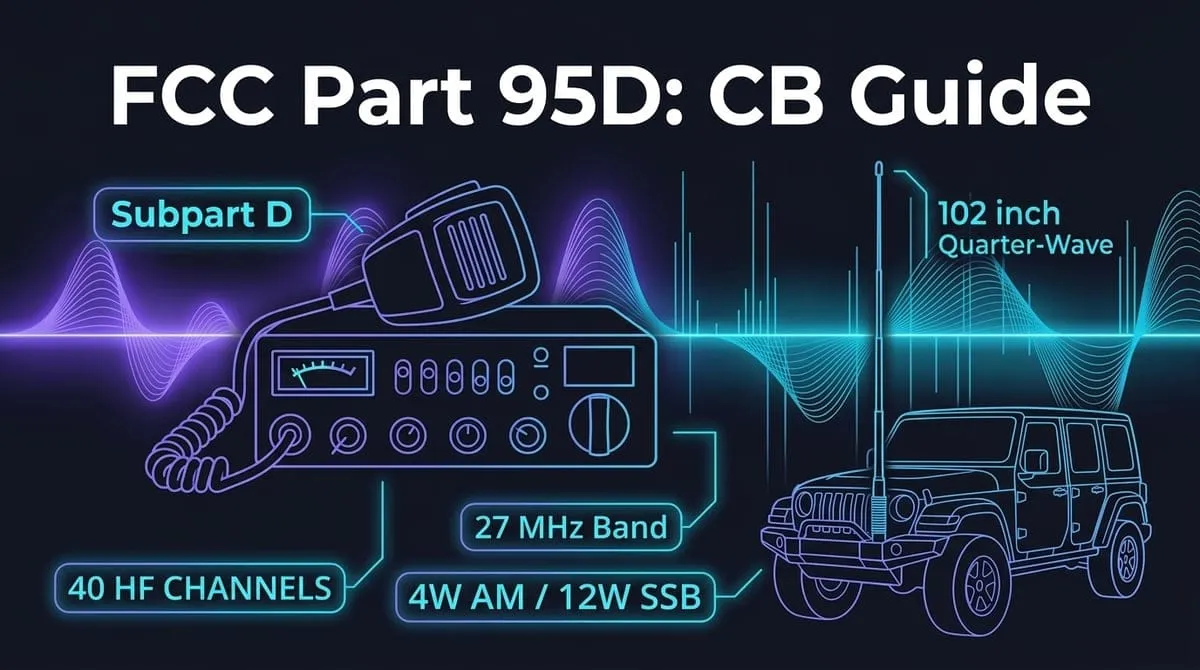
Nothing in American radio culture carries the mystique and folklore of the Citizens Band. From 1970s cross-country convoys and highway trucker lore on Channel 19 to smoky mountain basements running 9-foot steel whips, CB radio shaped how everyday Americans thought about wireless communication.
Today, while GMRS dominates off-road vehicle runs and FRS fills consumer blister packs, CB remains an active, distinct radio service. Governed by Title 47, Part 95, Subpart D of the Code of Federal Regulations (47 CFR Part 95 Subpart D)—officially known as the Citizens Band Radio Service (CBRS)—it operates in a completely different corner of the RF spectrum and follows an entirely different set of rules than its UHF siblings.
In recent years, the FCC has quietly modernized Subpart D: removing outdated distance caps, clarifying certification requirements, and authorizing FM voice alongside traditional AM and Single Sideband (SSB).
This guide examines the legal and engineering realities of operating a CB station today, separating decades of CB myths from federal regulations.
Primary Sources: Rules cited in this guide reflect current Title 47 Part 95 rules published in the eCFR, including the 2017 Part 95 Personal Radio Service Reform (FCC 17-57, 82 FR 41104), the 2021 CB FM Report and Order (FCC 21-90, 86 FR 53563), and the direct final certification cleanup order (FCC 25-77, 90 FR 57698, effective February 10, 2026).
01 · What CB Actually Is (§ 95.903)
The FCC defines the Citizens Band Radio Service under 47 CFR § 95.903 as a mobile and fixed two-way voice communication service for personal, business, or voluntary public-service activities, including assistance to highway travelers.
A few fundamental baseline facts separate CB from other personal radio services:
- HF Spectrum, Not UHF: CB operates in the High Frequency (HF) band around 27 MHz (11 meters). Its signals behave like shortwave radio, interacting with the earth, structures, and the ionosphere in ways that 462 MHz UHF signals never do.
- CBRS vs. Part 96: In FCC regulatory text, the historical abbreviation for Citizens Band Radio Service is CBRS. This must not be confused with commercial Part 96 Citizens Broadband Radio Service (the 3.5 GHz LTE/5G wireless band). In Part 95 Subpart D, CBRS means 27 MHz two-way voice.
- External Antennas Are Fully Permitted: Unlike FRS, CB operators are free to install base station antennas, magnetic roof mounts, and large vehicular whips.
- Three Voice Modulation Modes: You can legally transmit using AM, FM, or SSB.
- The Compliance Rule: Operating lawfully requires answering three distinct questions:
- Are you an authorized operator? (§ 95.305 / § 95.905)
- Is the transmission permitted? (§ 95.931 / § 95.933)
- Is the transmitter certified specifically for Part 95 Subpart D? (§ 95.335 / § 95.935)
02 · Authorized by Rule & Business Coordination (§ 95.305, § 95.905)
Between 1958 and 1983, operating a Class D CB radio required an individual station license and an FCC-issued call sign. In 1983 (PR Docket 82-799, 48 FR 24884), the Commission eliminated individual licensing, converting CB to authorized-by-rule operation under 47 CFR § 95.305.
That authorization is conditional:
- No application, fee, or exam: Anyone who is not a representative of a foreign government acting in an official capacity and not under an FCC cease-and-desist order can pick up a microphone and talk.
- Break the rules, void your authority: Under 47 CFR § 95.905, violating the operating rules automatically voids your authority to operate without an individual license. Connecting an illegal amplifier or transmitting outside the 40 channels turns you into an unlicensed transmitter under federal law.
- Business use is legal: Farming operations, towing companies, delivery drivers, and construction sites can use CB radios for daily logistics. However, business permission has boundaries: under § 95.933(b), transmitting commercial advertising, pitching products, or soliciting sales over the air is strictly prohibited.
- Handles are not FCC call signs: The FCC no longer assigns individual CB call signs. Operators frequently use on-air “handles” or tactical call names. While helpful for identifying speakers in a convoy, a handle is an informal social custom, not an official license or channel reservation.
03 · Operating Boundaries & The Foreign Station Ban (§ 95.307, § 95.933)
Where can you operate, and who can you talk to?
Under 47 CFR § 95.307, authorized CB operation is permitted:
- Throughout all 50 U.S. states and the District of Columbia.
- In U.S. territories and insular areas.
- Aboard U.S.-registered vessels and aircraft with the explicit permission of the vessel captain or pilot in command (§ 95.307(b)).
47 CFR § 95.933(d): CB operators in the United States are strictly barred from communicating with stations in other countries, with exactly one statutory exception: General Radio Service (GRS) stations in Canada. Even if atmospheric skip brings in clear signals from Mexico, the Caribbean, Europe, or Australia, transmitting a reply to a non-Canadian foreign station violates federal law.
Section 95.309 also notes geographic zones where RF power and tower heights face strict restrictions, such as the National Radio Quiet Zone in Green Bank, West Virginia, and designated radio astronomy observatories.
04 · Permitted Traffic, Directed Paging & Channel 9 (§ 95.931, § 95.933)
Permitted communications over CB are centered on plain-language voice:
Lawful Traffic
Under 47 CFR § 95.931, stations may transmit:
- Two-way voice communications between CB stations.
- Emergency distress communications and traveler assistance.
- Brief radio checks (testing transmitter audio).
- Road hazard warnings and traffic condition alerts.
- Directed voice paging: Transmitting a brief one-way call to summon a specific person to the radio (e.g., “Unit 4, please call the warehouse desk” under § 95.931(b)(4)). This does not authorize open public-address broadcasts over the airwaves.
Prohibited Operations (§ 95.933)
Subpart D explicitly bans several common operating abuses:
- Advertising: Soliciting the sale of goods or services.
- Political campaign broadcasts: Promoting political candidates or campaigns over the air (though internal campaign organizational logistics are permitted).
- Music & entertainment: Playing recorded music, whistling, or broadcasting sound effects intended to entertain or draw attention.
- Relaying commercial media: Retransmitting live or recorded commercial radio or television broadcasts.
- Intentional interference: Keying a microphone to jam or step on other conversations.
Emergency Channel 9 (27.065 MHz)
Section 95.931(a) restricts Channel 9 (27.065 MHz) strictly to:
- Emergency communications involving the immediate safety of life or the protection of property.
- Communications necessary to assist a traveler reach a destination or obtain emergency roadside help.
Channel 9 is not an open calling channel, a radio-check channel, or a place to hold casual chats. Keeping Channel 9 clear preserves emergency access for remote highway motorists.
05 · The 5-Minute Conversation Limit (§ 95.957)
One of the most widely overlooked provisions in the entire Part 95 rulebook is 47 CFR § 95.957:
“Each conversation on a CB channel must be limited to five minutes. Once a conversation ends, stations must wait at least one minute before transmitting on the same channel again.”
[ Conversation Starts ] ──> Maximum 5 Minutes Continuous ──> [ Conversation Ends ] │ Mandatory 1-Minute Quiet Pause Before Re-Keying on Same ChannelHow the Timer Works
- The limit applies to the entire conversation, not each individual push-to-talk transmission. Two operators making short alternating 10-second transmissions back and forth are engaged in a single ongoing conversation.
- Once that conversation concludes, the operators cannot resume transmitting on that channel until at least 60 seconds have passed.
- The Exceptions (§ 95.957(b)–(c)): The five-minute limit and one-minute pause are waived during direct participation in emergency communications or when assisting a traveler.
The goal of this rule is simple: because all 40 CB channels are shared public resources, no two stations can monopolize a frequency indefinitely.
06 · The 40 Channels & Frequency Structure (§ 95.963)
CB frequencies are allocated across 40 shared channels between 26.965 MHz and 27.405 MHz:
| Channel | Frequency (MHz) | Common Field Use | Channel | Frequency (MHz) | Common Field Use |
|---|---|---|---|---|---|
| 1 | 26.965 | General Simplex | 21 | 27.215 | General Simplex |
| 2 | 26.975 | General Simplex | 22 | 27.225 | General Simplex |
| 3 | 26.985 | General Simplex | 23 | 27.255 | Shared with RCRS (Out of order) |
| 4 | 27.005 | 4x4 / Off-Road Convoy | 24 | 27.235 | General Simplex (Out of order) |
| 5 | 27.015 | General Simplex | 25 | 27.245 | General Simplex (Out of order) |
| 6 | 27.025 | “Superbowl” High-Power AM | 26 | 27.265 | General Simplex |
| 7 | 27.035 | General Simplex | 27 | 27.275 | General Simplex |
| 8 | 27.055 | General Simplex | 28 | 27.285 | General Simplex |
| 9 | 27.065 | Emergency & Motorist Assistance Only | 29 | 27.295 | General Simplex |
| 10 | 27.075 | Regional Highway / Logging | 30 | 27.305 | General Simplex |
| 11 | 27.085 | Historical Calling Channel | 31 | 27.315 | General Simplex |
| 12 | 27.105 | General Simplex | 32 | 27.325 | General Simplex |
| 13 | 27.115 | Marine / RV Convoy | 33 | 27.335 | General Simplex |
| 14 | 27.125 | General Simplex | 34 | 27.345 | General Simplex |
| 15 | 27.135 | General Simplex | 35 | 27.355 | General Simplex |
| 16 | 27.155 | 4x4 / Off-Road Convoy | 36 | 27.365 | SSB Calling (Informal) |
| 17 | 27.165 | Interstate North-South Trucks | 37 | 27.375 | SSB Ragchew |
| 18 | 27.175 | General Simplex | 38 | 27.385 | National LSB Calling Channel |
| 19 | 27.185 | National Highway / Trucker Calling | 39 | 27.395 | SSB Ragchew |
| 20 | 27.205 | General Simplex | 40 | 27.405 | Upper Band Edge Simplex |
Frequency Out-of-Order Quirk
Notice the jump at Channel 23:
- Channel 22 is 27.225 MHz.
- Channel 23 jumps up to 27.255 MHz.
- Channel 24 drops down to 27.235 MHz.
- Channel 25 sits at 27.245 MHz.
This historical quirk dates back to the original 1958 Class D channel allocation, where frequencies were assigned around existing radio-control operations.
The Hidden RCRS Gaps
Between several CB channels sit 10 kHz frequency gaps that are not part of the CB channel list. These five frequencies are assigned to the Radio Control Radio Service (RCRS) under 47 CFR Part 95 Subpart C (§ 95.763(a)):
- 26.995 MHz (between Channels 3 & 4)
- 27.045 MHz (between Channels 7 & 8)
- 27.095 MHz (between Channels 11 & 12)
- 27.145 MHz (between Channels 15 & 16)
- 27.195 MHz (between Channels 19 & 20)
(In addition, 27.255 MHz is shared between RCRS and CB Channel 23.)
These gaps are designated for remote-controlling model aircraft and surface vehicles. They are not “secret channels,” and transmitting voice over them using modified gear violates federal law.
07 · The Three Voice Modes: AM, FM & SSB (§ 95.971)
Under 47 CFR § 95.971, CB transmitters may utilize three distinct voice emission types:
- AM (Amplitude Modulation —
A3E): The historical standard. Carrier power is modulated on both the upper and lower sidebands. - FM (Frequency Modulation —
F3E): Authorized in 2021 by Report and Order FCC 21-90 (WT Docket 19-140). FM provides quiet, static-free background audio for close-range vehicle convoys without the atmospheric crackle of AM. - SSB (Single Sideband —
J3E,R3E,H3E): Suppressed-carrier Single Sideband strips away the carrier and one sideband, channeling transmitter power solely into the information-bearing voice slice. Under § 95.971(b), an SSB-capable CB radio must support Upper Sideband (USB); Lower Sideband (LSB) is optional, though LSB on Channel 38 is the universal community standard.
Incompatible Modes Cannot Communicate: Operating on the same channel number does not guarantee you can talk. If one truck transmits in FM on Channel 19 and another listens in AM, the AM radio hears distorted hash or muffled noise. Similarly, listening to an SSB transmission on an AM receiver produces unintelligible “Donald Duck” audio. Both operators must match both their frequency and their modulation mode.
08 · Power Limits & Modulation Math (§ 95.967, § 95.975)
Transmitter power in CB is governed by 47 CFR § 95.967:
| Mode | Maximum Legal Power | Power Measurement Metric |
|---|---|---|
| AM (Amplitude Modulation) | 4.0 Watts | Mean Carrier Power |
| FM (Frequency Modulation) | 4.0 Watts | Mean Carrier Power |
| SSB (Single Sideband) | 12.0 Watts | Peak Envelope Power (PEP) |
Notice that unlike FRS, which measures power at the antenna as ERP, CB power limits are measured directly at the transmitter antenna terminal.
Why 12W PEP Does Not Mean “Three Times AM Power”
A common misunderstanding is that a 12-Watt SSB radio outputs three times more power than a 4-Watt AM radio. That comparison confuses carrier power with peak envelope power.
In conventional AM, the radio outputs a continuous 4-Watt carrier wave even when nobody speaks. When you speak into the microphone at 100% modulation (), voice sidebands add power on top of that carrier.
For an ideal symmetrical sine-wave modulation at 100%:
A fully compliant 4-Watt AM transmitter naturally generates 16 Watts PEP at peak voice modulation. This explains why a peak-reading wattmeter swings well above 4 Watts when you talk on a legal AM radio.
SSB concentrates all 12 Watts of its peak energy directly into the voice signal without wasting power on a steady carrier. Under weak-signal and high-noise conditions, an SSB signal cuts through far more effectively than 4 Watts of standard AM.
Modulation Limiter Rules (§ 95.975)
- AM Modulation: Must be maintained between 85% and 100%. Transmitters with power exceeding 2.5 Watts must include an Automatic Modulation Control (AMC) circuit preventing modulation from exceeding 100% (§ 95.975(b)).
- FM Peak Deviation: Capped at ±2.0 kHz (§ 95.975(c)). (Do not confuse this with FRS’s ±2.5 kHz or GMRS’s ±5.0 kHz deviation limits).
09 · Technical Standards: Bandwidth, Drift & Masks
Subpart D sets strict technical boundaries to keep adjacent channels clean:
| Parameter | FCC Subpart D Limit | Rule Citation |
|---|---|---|
| AM / FM Occupied Bandwidth | Maximum 8.0 kHz | 47 CFR § 95.973(a) |
| SSB Occupied Bandwidth | Maximum 4.0 kHz | 47 CFR § 95.973(b) |
| Carrier Frequency Tolerance | Within ±50 ppm (approx. ±1.36 kHz) | 47 CFR § 95.965 |
| FM Peak Deviation | Maximum ±2.0 kHz | 47 CFR § 95.975(c) |
| Harmonic Suppression | Attenuated by at least 60 dB | 47 CFR § 95.979(a)(6) |
Carrier Accuracy Math
Under § 95.965, the carrier frequency must remain within ±50 parts per million (ppm) across operating temperatures.
On Channel 19 (27.185 MHz), that calculation yields:
The transmitter carrier may drift by approximately 1.36 kHz without violating the tolerance ceiling.
Emission Mask (§ 95.979)
Transmitters must attenuate out-of-band emissions relative to carrier output power:
- Inner band (4 to 8 kHz from center on AM/FM; 2 to 6 kHz on SSB): Attenuated by at least 25 dB.
- Next band (8 to 20 kHz from center on AM/FM; 6 to 10 kHz on SSB): Attenuated by at least 35 dB.
- Beyond 250% authorized bandwidth: Attenuated by .
- Carrier Harmonics (§ 95.979(a)(6)): All harmonic frequencies (e.g., 54 MHz, 81 MHz) must be attenuated by at least 60 dB below the unmodulated carrier power. This prevents CB transmissions from bleeding into low-VHF public safety and television bands.
10 · External Antennas, Height Limits & The RF Ground (§ 95.941)
Because CB operates at 27 MHz, antenna physics are wildly different from UHF handhelds:
A full quarter-wave vertical antenna () is approximately 108 inches (9 feet) tall.
Mobile Vehicle Antennas
Because driving with a 9-foot steel whip on a car roof is impractical for parking garages and highway bridges, mobile CB antennas rely on loading coils (base-loaded, center-loaded, or top-loaded fiberglass whips like the Firestik).
A loading coil inserts inductance to electrically tune a physically shortened wire (e.g., 3 to 5 feet) to resonance at 27 MHz. However, shorter loaded whips have narrower operating bandwidth and lower radiation efficiency than a full quarter-wave whip.
DC Continuity vs. RF Counterpoise
One of the most common installation traps is testing a vehicle antenna mount with an ohmmeter, seeing 0.1 ohms to the frame, and assuming the antenna has an adequate ground plane.
At 27 MHz, DC ground is not an RF ground:
- A long thin grounding braid might show zero ohms on a DC meter, but presents high inductive reactance at 27 MHz.
- Vehicular antennas are monopoles that require a broad conductive sheet-metal surface to carry RF displacement return currents.
- Mounting an antenna on a fiberglass roof, plastic mirror bracket, or rear tailgate without a wide capacitive plane will result in high SWR, common-mode feedline current, and severe signal loss.
Antenna Placement & Radiation Pattern
Where you mount a whip on a vehicle dictates its directional pattern:
- Center of a steel roof: Provides a symmetrical counterpoise in all directions, yielding an omnidirectional radiation pattern.
- Bumper or rear fender mount: Distorts the signal, sending the strongest radiation forward across the mass of the vehicle engine and body, while reducing range directly behind the bumper.
Height Limits for Base Stations (§ 95.941)
Under 47 CFR § 95.941, a CB base station transmitting antenna cannot exceed:
- 60 feet (18.3 meters) above ground level, OR
- 20 feet (6.1 meters) above the highest point of the building or tree on which it is mounted.
Whichever height allowance is higher governs your installation, subject also to FAA Part 17 aviation clearance rules near airports.
11 · 27 MHz Propagation, Skip & The Repealed 150-Mile Rule
Radio signals at 27 MHz travel via two distinct mechanisms:
- Ground Wave (Local Comms): Signals travel line-of-sight and hug the curvature of the earth. In average suburban or rolling highway terrain, vehicle-to-vehicle range is typically 2 to 8 miles. A well-tuned base station with a high antenna can reach 10 to 20 miles.
- Skywave (“Skip”): Because 27 MHz sits at the high end of the HF spectrum, changes in solar activity, solar sunspots, and sporadic-E ionospheric layers bend 27 MHz signals back down to earth hundreds or thousands of miles away.
During solar cycle peaks, CB channels suddenly erupt with voices from Texas, California, Florida, or Canada blasting in at signal strengths that drown out local drivers.
Transmitting Antenna ──> [ Ionospheric F2 Layer Refraction ] ──> Receiver 1,500 Miles Away (Skywave "Skip" Path Bypasses Earth Curvature and Local Obstacles)The 2017 Repeal of the 150-Mile Cap
Historically, 47 CFR § 95.413 strictly prohibited communicating with any CB station located more than 250 kilometers (155.3 miles) away. The rule was virtually unenforceable because operators cannot prevent the ionosphere from reflecting signals.
In the 2017 Part 95 Reform (Report and Order FCC 17-57, paragraphs 69–70), the FCC officially repealed the 150-mile distance restriction.
Today, talking to a station across the country during a natural propagation opening is completely lawful, provided:
- You remain within the legal power limits (4W AM/FM, 12W PEP SSB).
- You observe the 5-minute conversation limit (§ 95.957).
- You do not communicate with foreign stations outside Canada (§ 95.933(d)).
12 · The Uncompromising Ban on Linear Amplifiers (§ 95.939, § 95.935)
The most infamous corner of CB culture is the illegal RF linear amplifier. Often sold under names like “footwarmers,” “kickers,” or “linears,” these boxes boost power from 4 Watts to 200, 500, or 1,500 Watts.
The FCC’s stance is uncompromising:
47 CFR § 95.939: Absolute Prohibition
“External RF power amplifiers may not be used to increase CB transmitting power. There are no exceptions.”
Operating an amplifier on CB airwaves violates federal law. High-power 27 MHz amplifiers lack proper harmonic filtering, spraying broadband interference into home electronics, broadband routers, and municipal public safety frequencies.
Furthermore, under § 95.939(a), the FCC establishes an evidentiary presumption: having an external amplifier on station premises, combined with evidence of excessive transmitting power, serves as legal proof of a violation.
The “Export” & 10-Meter Radio Trap (§ 95.935)
Many CB shops market unlocked “10-meter amateur radios” or “export radios” that feature multi-band rotary switches covering 25.615 MHz to 28.305 MHz.
Under 47 CFR § 95.935:
- You cannot use a non-CB-certified radio to communicate with CB stations.
- Turning down the output power of an amateur radio to 4 Watts and tuning to Channel 19 does not make it a lawful CB radio.
- The transmitter must hold an official FCC Part 95 Subpart D certification grant.
The “Clipped Limiter” Splatter Trap
Shops often offer “peak and tune” services that clip the diode in the Automatic Modulation Control (AMC) limiter circuit.
While this makes the audio louder and causes wattmeters to swing higher, it drives the amplifier stage into severe hard clipping. The resulting flat-topped waveform produces square waves that spray harmonics and audio distortion across 5 channels in both directions, directly violating § 95.337, § 95.339, and § 95.979.
13 · Remote Control, VOX & Supervised Phone Patching (§ 95.945, § 95.949)
Subpart D maintains clear boundaries on remote operation and networking:
- No Wireless Remote Control (§ 95.945): You cannot control a CB base station across a wireless link. Wired remote control requires prior written FCC authorization. (Bluetooth wireless microphones and hands-free headsets authorized under Part 15 are explicitly permitted and not classified as remote control).
- Attended VOX Operation (§ 95.343): Hands-free voice-operated microphones are lawful, provided the operator remains at the control point. Using VOX for unattended automated audio relay is prohibited.
- Supervised Phone Interconnects (§ 95.949): CB permits connecting a radio station to the telephone network (a “phone patch”), but with strict operational safeguards:
- An operator must manually initiate and monitor every phone patch conversation.
- The operator must immediately terminate the call if rules are violated.
- Automated, unattended internet gateways or autonomous cross-band repeaters are barred.
14 · Field Operator Checklist & Troubleshooting
To keep your CB station performing cleanly and legally:
| Issue | Likely Cause | Solution |
|---|---|---|
| Garbled / Buzzing Audio | Mode mismatch (AM vs FM) | Verify both stations are set to the same mode (AM, FM, or SSB). |
| “Donald Duck” Audio | SSB received on AM | Switch receiver to SSB; select USB or LSB; adjust the Clarifier knob to tune voice pitch. |
| High SWR Across All Channels | Missing RF counterpoise or bad coax | Check antenna mount bonding to vehicle sheet metal; ensure mount is not isolated by paint or powder coat. |
| Audio Loud but Distorted | Overmodulation / clipped limiter | Reduce microphone gain; have the AMC circuit aligned to factory specs under § 95.975. |
| Excessive Engine Whine | Alternator noise coupling | Install an inline DC power filter on the 12V lead and bond vehicle tailpipes and hood to the chassis. |
Rules for the Road
- Monitor Channel 19: Keep your ear on 27.185 MHz while driving for live traffic hazard and road condition reports.
- Leave Channel 9 for Help: Never use 27.065 MHz for routine chat or testing.
- Mind the 5-Minute Clock: Keep long ragchews concise, and leave breathing room on the channel between exchanges.
- Run Certified Stock Gear: Avoid linear amplifiers and clipped limiters; invest your money in antenna height and feedline quality instead.