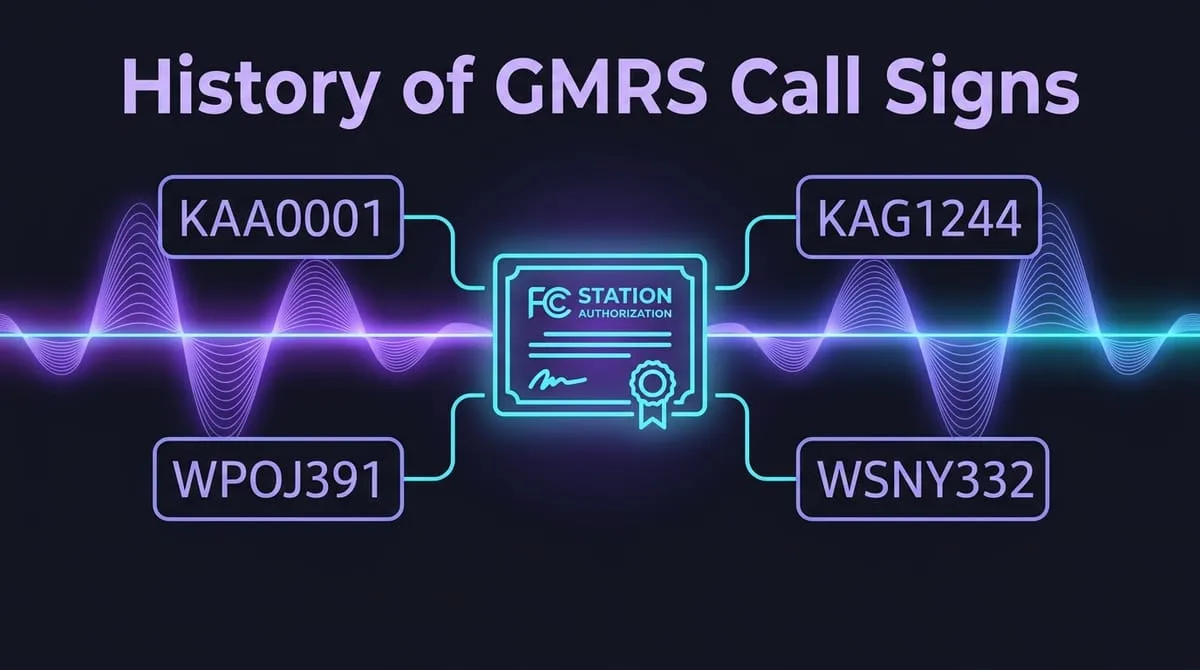
If you hold a GMRS license today, your call sign looks something like WSNY332, WRXY456, or WQAB789. It follows a 7-character alphanumeric pattern assigned sequentially by the Federal Communications Commission (FCC) Universal Licensing System (ULS).
However, if you listen to older operators on regional repeaters or examine vintage radio documentation from the 1970s and 1980s, you will encounter call sign formats that look completely different: 6-character strings starting with KAA, 7-character strings starting with KAF, or even grandfathered corporate licenses.
This notebook reference provides a strict, primary-sourced history of GMRS station call signs—from the 1949 Class A Citizens Radio Service to 1980s temporary permits, 1988 corporate grandfathering, and the April 1999 ULS migration.
Primary-Sourced Regulatory Evidence: Facts in this guide are presented as verified only when supported by FCC orders, Federal Register notices, the Code of Federal Regulations (CFR/eCFR), GovInfo, or equivalent primary regulatory sources. Community database findings (such as myGMRS ULS searches) are identified separately. Where no primary regulatory source has been located, this document states the limitation directly rather than filling gaps with speculation.
01 · What a GMRS Call Sign Authorizes (§ 95.1705)
A General Mobile Radio Service (GMRS) call sign is the regulatory station authorization identifier assigned by the Federal Communications Commission.
Unlike Amateur Radio (Ham) licenses—which license an individual operator at an earned technical qualification tier—a GMRS license authorizes a system of stations, including base, mobile, handheld, and repeater stations, under a single call sign.
- Family Operating Privileges (47 CFR § 95.1705(c)): An individual GMRS licensee may allow immediate family members to operate the licensee’s GMRS stations. The rule lists spouses, children, grandchildren, stepchildren, parents, grandparents, stepparents, brothers, sisters, aunts, uncles, nieces, nephews, and in-laws. The individual licensee remains legally responsible for proper station operation [1].
- Station Identification Rules (47 CFR § 95.1751): Stations must transmit their FCC call sign following a single transmission or series of transmissions, and at least every 15 minutes during continuous exchanges lasting longer than 15 minutes [2].
- Transmission Modes: Station identification must be transmitted using vocal English or audible International Morse code telegraphy. The current rule does not prescribe a Morse-code transmission speed limit. A unit number (e.g. “WSNY332 Unit 2”) may be included after the call sign [2].
- Repeater Exception: A GMRS repeater station is not required to transmit separate station identification if it retransmits only communications from GMRS stations operating under the same individual license and those originating stations are properly identified [2].
02 · The Service Before It Was Called GMRS (1949–1976)
FCC regulatory orders describe GMRS as the direct successor to the Class A service in the Citizens Radio Service. The FCC has traced future GMRS roots back to 1949, and later orders identify the 1976 redesignation of the Class A service as the General Mobile Radio Service when the Citizens Radio Service was reorganized into the Personal Radio Services under Docket 20120 [3].
- Class A & Class B (UHF): Class A authorized high-power UHF FM voice systems—historically specified as up to 60 Watts plate input power (yielding approximately 50 Watts transmitter output power, which aligns with today’s 50 Watt GMRS limit under 47 CFR § 95.1767)—and became the direct regulatory ancestor of GMRS. Class B was a companion low-power (5 Watt limit) 465 MHz UHF service for short-range portables that was later phased out.
- Class C & Class D (HF): Class C covered radio control for model aircraft and devices, while Class D (27 MHz AM) became what the public knows today as 11-meter CB radio.
1949: Class A Citizens Radio ──> 1976: GMRS Redesignation ──> 1999: ULS Migration (Radio Service Code ZA)That regulatory lineage matters for call-sign history. Older licenses granted under the Class A banner in the 462/467 MHz UHF allocation are part of the same administrative lineage as modern GMRS, rather than authorizations for an unrelated service. The early record is incomplete, however, and the limits of available evidence should remain visible.
03 · Historical Call-Sign Formats and Prefix Blocks
Early Class A Formats: An Open Archival Question
Some early Citizens Radio material and later community discussions refer to district-style call signs using FCC inspection or engineering district numbers (such as formats resembling 19W####). This reference does not present that style as a verified Class A GMRS format.
District-style call signs existed in the broader Citizens Radio era, but no primary FCC source located for this draft establishes exactly which district-style formats were assigned specifically to Class A stations.
K-Series Call Signs: In Evidence Before 1976
The K-series did not begin with the 1976 GMRS redesignation. Historical FCC call-sign composition rules show that by the late 1960s (specifically verified in 1969 regulatory evidence), Personal Radio call-sign blocks included three-letter/four-digit combinations beginning at KAA0001. 47 CFR § 2.302 also lists Personal Radio call-sign blocks in the KAA0001–KZZ9999 range alongside related Personal Radio W-series blocks, and that row is still in the current table [4].
Surviving Class A/GMRS licensing records show actual assignments progressing through prefixes including KAA, KAB, KAC, KAD, KAE, KAF, and KAG. However, no primary FCC source located to date explains the internal assignment algorithm, identifies KAA–KAG as a formally reserved GMRS-only pool, or documents the opening and exhaustion dates for each prefix.
Why Modern W-Series Calls Don’t Appear in § 2.302
The current § 2.302 Personal Radio row still reads “3 letters, 4 digits, or 4 letters, 4 digits,” with blocks running KAA0001 through KZZ9999, WAA0001 through WPZ9999, and KAAA0001 through KZZZ9999. A modern GMRS call sign like WSNY332 is four letters and three digits, so it matches none of those shapes.
That is not a discrepancy. The table’s own opening sentence sets its scope: it “indicates the composition and blocks of international call signs available for assignment when such call signs are required by the rules pertaining to particular classes of stations.” Modern GMRS call signs are not drawn from that table at all—ULS issues them sequentially from the wireless W-series pool, which is why the K-series blocks in § 2.302 describe the pre-1999 era and the post-1999 format does not appear there.
04 · Temporary Operating Identifier: WT Permits (1982–1983)
The WT temporary call-sign format is verified in historical FCC regulations. Historical FCC call-sign rules listed a General Mobile Radio Service temporary permit as two letters and seven digits, using WT plus the applicant’s business or residence telephone number (e.g. WT-5551234) [4].
Later FCC Form 605 Schedule F instructions used the same WT plus telephone-number format for a GMRS temporary operator permit while an application was being processed [5].
On August 3, 1983, final rules published at 48 FR 35234 codified GMRS rule revisions in PR Docket 82-84 (FCC 83-332) [6].
05 · 1983 System Licensing
The 1983 GMRS rule revision reinforced the concept of system licensing. Rather than treating every transmitter as requiring a separate user-style call sign, GMRS licensing covered a communications system: base, mobile, portable, control, and repeater stations operating under one authorization.
This explains why a single GMRS call sign identifies the licensed system, not a personal operator qualification comparable to an Amateur Radio license. One system authorization carried one station identification across the entire covered GMRS system.
06 · The 1988 Eligibility Reform & Corporate Grandfathering
In 1988, the FCC adopted a Report and Order overhauling GMRS eligibility rules to make GMRS more efficient for personal users and discourage commercial Business Radio Service crowding [7]. DA 03-2928 summarizes that order without naming a docket, so the PR Docket 87-265 number stays an open citation.
- New Applications: Limited strictly to individual persons meeting eligibility requirements.
- Grandfathered Non-Individual Licensees (47 CFR § 95.1705(g)): Entities licensed before July 31, 1987 could continue operating under grandfathering rules, but authorization was restricted to the specific stations, locations, channels, antenna heights, and transmitter powers authorized for that grandfathered system [1].
- No Modifications or Transfers: Grandfathered GMRS licenses authorize continued operation of those specific stations, but the FCC does not accept applications to modify, assign, or transfer grandfathered corporate licenses except for administrative contact updates [1].
07 · The April 1999 ULS Cutover: The K-to-W Transition
In the late 1990s, the FCC moved wireless licensing into the Universal Licensing System (ULS) under WT Docket 98-20 (63 FR 68951) [8].
FCC Public Notice DA 99-1080 (released June 3, 1999) listed GMRS as available in ULS in April 1999 [9]. The ZA service code is not in that notice. It is documented on the FCC Wireless Bureau’s own GMRS page, which lists “Radio Service Code(s) - ZA - GMRS” [14].
Legacy K-Series (Pre-April 1999) ──────> Modern W-Series (Post-April 1999) Example: KAG1244 Example: WPOJ391 / WSNY332 (3 Letters + 4 Digits) (4 Letters + 3 Digits)April 19, 1999 is treated as the documented GMRS ULS cutover point. Coincident with that transition, newly issued GMRS licenses changed from the legacy 3-letter/4-digit K-series format to 4-letter/3-digit W-series call signs (WQ, WR, WS).
Boundary Examples (KAG1244 vs. WPOJ391)
Community researchers cross-referencing direct FCC ULS database queries identify specific boundary grants [10]:
KAG1244: Reported as the final identified K-series GMRS grant on April 9, 1999.WPOJ391: Reported as the first identified W-series GMRS grant on April 19, 1999.
The interval between those two grants coincides with the FCC’s documented April 1999 GMRS migration into ULS. However, located primary sources do not state that licensing was suspended throughout the entire interval, so it should be viewed as an administrative migration window rather than a proven ten-day shutdown.
08 · Geographic Distribution and the Broadcast K/W Myth
In United States broadcast radio, stations west of the Mississippi River generally receive K call signs while stations east receive W call signs (under 47 CFR § 73.3550) [11].
This broadcast convention does not apply to GMRS. No evidence indicates that Class A Citizens Radio or GMRS used the broadcast K-west / W-east geographic convention. Surviving licenses show K-series call signs issued nationwide before 1999 and W-series call signs issued nationwide afterward. Modern GMRS W-prefix licenses west of the Mississippi are fully consistent with a non-geographic assignment process.
09 · The 2017 Part 95 Personal Radio Reform
FCC Order FCC 17-57 (released May 19, 2017 in WT Docket 10-119) comprehensively reorganized Part 95, moving GMRS operating rules into Subpart E [12].
- Combination Radio Reclassification: Combination FRS/GMRS handheld radios whose capabilities complied with revised FRS technical rules could thereafter operate as FRS devices without an individual license. Radios capable of operating above FRS power limits or transmitting on 467 MHz GMRS repeater inputs remained classified as GMRS devices requiring a license [12].
- 10-Year License Term (47 CFR § 95.1705(e)): FCC 17-57 extended the normal individual GMRS license term from five years to ten years [1, 12].
10 · Modern W-Series Allocation & 2022 Fee Reduction
In December 2020, the FCC adopted a revised fee schedule in MD Docket 20-270. FCC Public Notice DA 22-307 announced that the new Wireless Telecommunications Bureau application rates codified at 47 CFR § 1.1102 became effective April 19, 2022 [13].
The GMRS application fee was reduced from $70 to $35, creating a significant milestone in licensing volume while W-series prefix blocks progressed through WQ, WR, and into WS.
11 · Summary Regulatory Timeline
| Period / Date | Event | Impact on Call-Sign History | Primary Evidence |
|---|---|---|---|
| 1949 | Class A Citizens Radio Established | Beginning of regulatory lineage later known as GMRS. | FCC DA 06-2623 & DA 03-2928 [3, 7] |
| Late 1960s | KAA Block Introduced | Personal Radio call-sign blocks included 3-letter / 4-digit KAA formats. | Historical 47 CFR § 2.302 [4] |
| 1976 | Class A Redesignated GMRS | Class A formally renamed GMRS under Docket 20120. | FCC DA 06-2623 [3] |
| 1982–1983 | WT Temporary Permits | WT + telephone number verified as temporary operating identifier (48 FR 35234 / PR Docket 82-84). | 47 CFR § 2.302; 48 FR 35234 [4, 6] |
| 1983 | System Licensing Emphasized | One GMRS authorization and call sign covers a system of stations. | 1983 GMRS Rule Revision [6] |
| 1988 | Individual-Only Eligibility | New entity licenses ended; pre-July 31, 1987 corporate systems grandfathered. | 1988 Report and Order (DA 03-2928); 47 CFR § 95.1705(g) [1, 7] |
| April 1999 | GMRS Migrated into ULS (ZA) | Coincident change from K-series to W-series call signs on April 19, 1999. | FCC DA 99-1080 [9] |
| April 9, 1999 | KAG1244 Grant | Final presently identified K-series GMRS grant in community ULS records. | myGMRS ULS search [10] |
| April 19, 1999 | WPOJ391 Grant | First presently identified W-series GMRS grant in community ULS records. | myGMRS ULS search [10] |
| May 19, 2017 | FCC 17-57 Released | Part 95 reorganized; combination radios reclassified; GMRS term extended to 10 years (§ 95.1705(e)). | FCC 17-57 [12] |
| April 19, 2022 | WTB Fee Reduction Effective | GMRS application fee reduced from $70 to $35 under DA 22-307. | FCC DA 22-307 [13] |
12 · Evidentiary Status & Outstanding Archival Inquiries
Verified from Primary FCC, Federal Register, CFR, or GovInfo Sources
- GMRS traces its regulatory lineage to Class A Citizens Radio Service established in 1949.
- Class A was redesignated as GMRS in 1976 under Docket 20120.
- Current GMRS station identification uses English voice or audible International Morse code telegraphy without a Morse-speed limit (§ 95.1751).
- § 95.1751 includes the same-license repeater identification exception.
- § 95.1705(c) lists eligible family members who may operate under an individual license.
- § 95.1705(e) establishes the 10-year individual GMRS license term.
- § 95.1705(g) tightly limits grandfathered non-individual GMRS licenses.
- FCC rulemaking and Public Notice DA 99-1080 place GMRS in ULS in April 1999. The
ZAservice code is documented on the FCC’s GMRS page, not in DA 99-1080. - FCC 17-57 reorganized Part 95 and extended license terms to 10 years.
- DA 22-307 made WTB application fee rates ($35) effective April 19, 2022.
Strong Community / Direct-Database Findings
KAG1244is reported by community ULS searches as the final identified K-series GMRS grant on April 9, 1999.WPOJ391is reported by community ULS searches as the first identified W-series GMRS grant on April 19, 1999.- The April 9 to April 19 interval coincides with ULS migration, but primary sources do not establish a proven 10-day licensing suspension.
Corrected & Refined Claims
- Removed outdated Morse-speed limits from current-rule discussions.
- Removed assertions that early district-style call signs (
19W####) are verified Class A GMRS calls (archival question). - Moved K-series evidence earlier than the 1976 GMRS redesignation (verified in 1969 historical 47 CFR § 2.302).
- Softened broadcast K/W claims to confirm no evidence found for Class A/GMRS use of broadcast geographic conventions.
- Corrected 2017 FRS/GMRS combination radio discussions to classify devices by capabilities under revised rules.
Outstanding Archival Research Tasks
- Locate primary FCC evidence for earliest Class A call-sign formats, including whether district-style formats were assigned specifically to Class A.
- Identify the first Class A/GMRS
KAA-series assignment and opening/exhaustion dates forKAAthroughKAGprefixes. - Verify
KAG1244andWPOJ391directly in historical FCC ULS transaction archives. - Search for FCC engineering or ULS implementation documentation explaining the internal reason for the K-to-W format change.
13 · Primary References and Citations
- 47 CFR § 95.1705, Individual licenses required; eligibility; who may operate; cooperative use. eCFR. ecfr.gov
- 47 CFR § 95.1751, GMRS station identification. eCFR. ecfr.gov
- FCC DA 06-2623, Garmin International, Inc., Order. Summarizes Class A 1949 origin and 1976 redesignation. fcc.gov
- 47 CFR § 2.302, Call signs. Historical composition tables for Personal Radio Services.
- FCC Form 605 Schedule F, Temporary Operator Permit Instructions.
- 48 FR 35234, General Mobile Radio Service Rules, PR Docket 82-84 / FCC 83-332 (August 3, 1983). govinfo.gov
- FCC DA 03-2928, Amendment of Part 95 Regarding GMRS License Eligibility (Oct. 10, 2003). Summarizes the 1988 Report and Order; does not name a docket number. fcc.gov
- 63 FR 68951, Development and Use of the Universal Licensing System, WT Docket 98-20.
- FCC DA 99-1080, WTB Reminds Licensees of Mandatory Electronic Filing via ULS (June 3, 1999). Lists GMRS as available in ULS in April 1999; contains no service code. fcc.gov
- myGMRS Forum Research, GMRS Call Signs From Years Ago. ULS database query findings (
KAG1244/WPOJ391). mygmrs.com - 47 CFR § 73.3550, Requests for new or modified call sign assignments (Broadcast rules).
- FCC 17-57, Personal Radio Service Reform, WT Docket 10-119 (May 19, 2017). fcc.gov
- FCC DA 22-307, Effective Date of New Application Fee Rates for Wireless Telecommunications Bureau (rel. March 23, 2022; rates effective April 19, 2022). fcc.gov
- FCC Wireless Telecommunications Bureau, General Mobile Radio Service (GMRS). Lists “Radio Service Code(s) - ZA - GMRS”. fcc.gov
Key Takeaways
A System Authorization, Not an Individual Tech Rating
Unlike Ham radio licenses, a single GMRS call sign covers an entire system of base, mobile, handheld, and repeater stations operated by the licensee and eligible family members (47 CFR § 95.1705(c)).
The April 1999 ULS Cutover
The transition from legacy K-series call signs (e.g. KAG1244) to modern W-series call signs (e.g. WPOJ391, WSNY332) happened when GMRS moved into ULS in April 1999 under Radio Service Code ZA. The FCC documents the month; community ULS queries put the boundary at April 19.
Evidentiary Rigor
Primary regulatory sources (CFR, FCC orders, Federal Register) document administrative milestones, while community ULS database queries provide exact boundary markers like KAG1244 and WPOJ391.