If you use GMRS today for family communication, off-grid trail runs, or emergency preparedness, you are operating on a service with a rich 75-year regulatory history.
Unlike Amateur Radio—which requires technical examinations—and 11-meter CB radio—which operates without individual licenses on HF frequencies—GMRS occupies a unique space: a UHF land-mobile system authorization service created specifically for individual and personal communications.
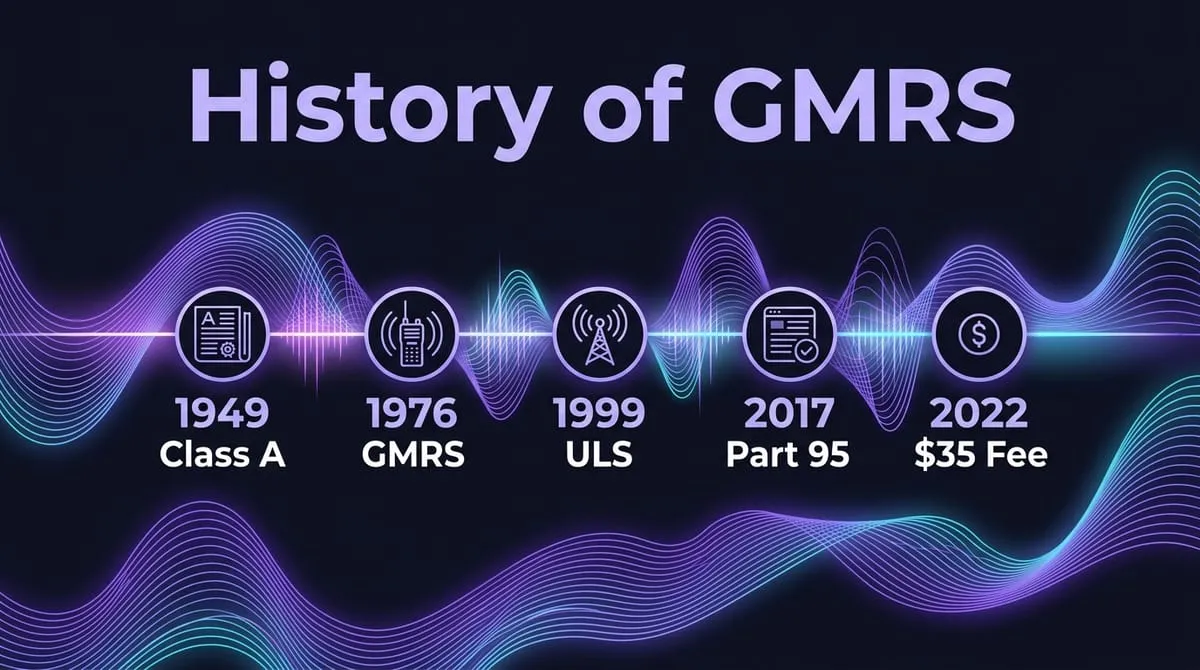
This reference provides a strict, primary-sourced history of the General Mobile Radio Service (GMRS)—from its post-WWII origins in Class A Citizens Radio to the 1976 redesignation, 1988 eligibility reform, 1999 ULS migration, and 2017 Part 95 Reform.
Primary-Sourced Regulatory Evidence: Historical milestones in this guide are presented as verified only when supported by FCC orders, Federal Register notices, the Code of Federal Regulations (eCFR), GovInfo, or equivalent primary regulatory sources. Where historical records remain incomplete or community explanations lack primary documentation, this document identifies the boundary directly.
01 · Post-War Origins: Class A Citizens Radio (1945–1949)
Following World War II, the Federal Communications Commission and the radio manufacturing industry sought ways to make short-range two-way radio communication available to the public outside established public safety, maritime, industrial, transportation, and amateur licensing frameworks.
Modern FCC regulatory summaries trace GMRS directly to the Class A Citizens Radio Service, established in 1949 [1].
- Class A Citizens Radio: The direct regulatory and spectral ancestor of GMRS.
- Class B Citizens Radio: A separate lower-power (5 Watt limit) 465 MHz UHF Citizens Radio class, not the modern Family Radio Service.
- UHF Land-Mobile Lineage: Future GMRS began as a UHF land-mobile style service in the 460–470 MHz allocation, not on 27 MHz HF and not as an amateur qualification tier.
02 · Distinguishing Historical Class B from Modern FRS
Class B Citizens Radio is sometimes conflated with the modern Family Radio Service (FRS) because both involved lower-power personal or short-range UHF voice communication. While historically interesting, the services are legally, chronologically, and technically distinct.
Class B was part of the original Citizens Radio framework and existed decades before FRS. FRS was established in 1996 under WT Docket 95-102 as a very short-range two-way voice personal radio service. Public Notice DA 06-2623 summarizes FRS as sharing seven 462 MHz frequencies with GMRS and using seven additional 467 MHz channels offset from GMRS channels [1].
FRS is licensed by rule, meaning compliant users do not obtain individual station licenses. Class B was an early low-power UHF Citizens Radio class; it was a conceptual predecessor to later short-range consumer UHF services, but it was not legally or technically FRS.
03 · The 1976 Redesignation: Class A Becomes GMRS
The 1976 milestone was a structural reorganization and renaming, not the creation of a brand-new service. Under Docket 20120, the FCC redesignated the Citizens Radio Service as the Personal Radio Services, and formally redesignated Class A as the General Mobile Radio Service (GMRS) [1].
1949: Class A Citizens Radio ──> 1976: GMRS Redesignation ──> 1999: ULS Migration (Radio Service Code ZA)This means historical Class A licenses granted under the 462/467 MHz UHF allocation belong to the exact same uninterrupted regulatory lineage as modern GMRS.
04 · GMRS Channelization, Power Limits, & The 22 vs. 30 Channel Breakdown
Consumer radios are commonly marketed around a 22-channel selector, but FCC regulations formally allot 30 GMRS channels under 47 CFR § 95.1763: 16 main channels and 14 interstitial channels [2].
The difference comes from repeater operation. A GMRS repeater receives on a 467 MHz input and retransmits on the paired 462 MHz output using a +5.000 MHz offset. Programmable GMRS radios expose these inputs as channels 23–30 or 15R–22R.
Channel Allocation Structure (47 CFR § 95.1763 & § 95.1767)
| Consumer Selector / Common Label | Frequency Group | Frequencies | Count | Role & Current Power Limits (§ 95.1767) |
|---|---|---|---|---|
| Channels 1–7 | 462 MHz Interstitial | 462.5625–462.7125 MHz | 7 | Shared with FRS. GMRS mobile, handheld, and base stations may transmit up to 5 W ERP [3]. |
| Channels 8–14 | 467 MHz Interstitial | 467.5625–467.7125 MHz | 7 | Shared with FRS. Restricted to handheld portable units transmitting up to 0.5 W ERP [3]. |
| Channels 15–22 | 462 MHz Main | 462.5500–462.7250 MHz | 8 | Simplex & Repeater Outputs. Mobile, handheld, repeater, and base stations may transmit up to 50 W TPO (15 W fixed) [3]. |
| Channels 23–30 / 15R–22R | 467 MHz Main | 467.5500–467.7250 MHz | 8 | Repeater Inputs. Mobile, handheld, and control stations may transmit up to 50 W TPO to a repeater. FRS operation is prohibited [3]. |
05 · The 462/467.675 MHz Pair & Emergency / Traveler Assistance
The 462/467.675 MHz channel pair has a distinct historical role in GMRS traveler assistance and emergency communications.
In FCC Order FCC 99-129 (released June 9, 1999), the Commission addressed a Personal Radio Steering Group (PRSG) petition regarding former 47 CFR § 95.29(e), which would have restricted the 675 MHz pair exclusively to traveler assistance and emergency traffic [4].
PRSG argued that strict restriction would force existing open repeater owners to discontinue routine personal-use traffic or move repeaters, ultimately reducing the number of open repeaters available for emergency calls. The FCC granted a partial stay of former § 95.29(e) while it evaluated the consequences [4].
Around this era, a 141.3 Hz CTCSS tone became a widely recognized community convention on open travel repeaters, though primary FCC rules do not mandate 141.3 Hz as an official nationwide tone.
06 · Technical Maturation, System Licensing, & 1980s Rules
1983 Rule Revisions (PR Docket 82-84 / 48 FR 35234)
In PR Docket 82-84 (FCC 83-332, 48 FR 35234), the Commission amended former § 95.29 to authorize 462 MHz interstitial channels (462.5625–462.7125 MHz) to relieve channel congestion from low-power mobile systems [5].
System Licensing Concept
The 1983 GMRS rule revision reinforced GMRS as a system licensing service. GMRS is not an operator-qualification service like Amateur Radio. A single GMRS authorization covers a complete communications system: base, mobile, portable, control, and repeater stations operating under one call sign.
WT Temporary Operating Permits
47 CFR § 2.302 lists a GMRS temporary permit call-sign composition of two letters and seven digits, using WT plus the applicant’s telephone number (e.g. WT-5551234). This served as a temporary operating identifier while permanent licensing proceeded, and the entry is still in the current call-sign table today [5].
07 · The 1988 Eligibility Reform & Corporate Grandfathering
The 1988 eligibility overhaul (summarized in DA 03-2928) established the personal character of modern GMRS to make GMRS more efficient for personal users and discourage commercial Business Radio Service crowding [6].
- New Eligibility: Limited strictly to individual persons and covering the licensee’s immediate family members (§ 95.1705(c)) [7].
- Grandfathered Non-Individual Systems (47 CFR § 95.1705(g)): Partnerships, corporations, associations, and governmental units licensed prior to July 31, 1987 could continue operating under grandfathering rules. However, authorization is restricted to specific authorized stations, locations, channels, antenna heights, and transmitter powers; the FCC does not accept modification or transfer applications except contact updates [6, 7].
08 · Universal Licensing System (ULS) Transition (1999)
In April 1999, the FCC transitioned private wireless radio licensing into the Universal Licensing System (ULS) under WT Docket 98-20 (63 FR 68951) [4].
Public Notice DA 99-1080 places GMRS in ULS in April 1999 [8]. The Radio Service Code ZA is documented separately, on the FCC Wireless Bureau’s own GMRS page, which lists “Radio Service Code(s) - ZA - GMRS” [13]. DA 99-1080 itself contains no service code. Coincident with entering ULS in April 1999, newly issued call signs transitioned from legacy 3-letter/4-digit K-series formats (KAG1244) to modern 4-letter/3-digit W-series formats (WPOJ391, WQAB789, WSNY332).
09 · The 2017 Part 95 Personal Radio Reform
On May 19, 2017, the FCC released FCC 17-57 in WT Docket 10-119, comprehensively reorganizing Part 95 and moving GMRS operating rules into Subpart E [9].
Reclassification of Combination Radios
FCC 17-57 reclassified consumer FRS/GMRS combination radios by technical capability. Radios complying with revised FRS criteria—including operation at 2 W ERP or less, narrowband operation, and integrated non-detachable antennas—could operate as license-free FRS devices. Radios exceeding FRS power limits or capable of transmitting on 467 MHz repeater inputs remained GMRS equipment requiring an individual license [9].
10-Year License Term (47 CFR § 95.1705(e))
FCC 17-57 extended the standard GMRS license term from 5 years to 10 years [7, 9].
Digital Data Standards (47 CFR § 95.1787)
Handheld portable GMRS units were authorized to transmit digital location data, location requests, and brief text messages (max 1 second duration, spaced at least 30 seconds apart) [10].
Emission Types & Digital Voice (47 CFR § 95.1771)
Current § 95.1771 authorizes only listed GMRS emission types (A1D, F1D, G1D, H1D, J1D, R1D, A3E, F3E, G3E, H3E, J3E, R3E, F2D, G2D) [11]. Proprietary digital voice modes such as DMR, P25, and NXDN use emission designators that are not on the authorized list, so they are not permitted for GMRS voice operation.
10 · Licensing Fee Restructuring (2020–2022)
Under MD Docket 20-270 / FCC 20-184, the Commission adopted an updated application fee schedule. Public Notice DA 22-307 announced that revised Wireless Telecommunications Bureau application rates codified at 47 CFR § 1.1102 became effective April 19, 2022 [12].
The GMRS application fee was reduced from $70 to $35, creating a major administrative milestone in nationwide operator licensing.
11 · Regulatory Evolution Summary Matrix
| Service | Active Period | Primary Frequencies | Technical & Power Notes | Licensing Model | Current Status |
|---|---|---|---|---|---|
| Class A Citizens Radio | 1949–1976 | 460–470 MHz (UHF) | 60 W plate input (~50 W TPO) — unverified | Station / System License | Redesignated as GMRS in 1976 [1] |
| Class B Citizens Radio | 1949–1960s | 465 MHz (UHF) | 5 W low-power portable — unverified | Station License | Phased Out (Not FRS) |
| GMRS | 1976–Present | 462/467 MHz Main & Interstitial | 50 W Main TPO, 5 W / 0.5 W Interstitial ERP | Individual / Family System License | Active (Part 95 Subpart E) [2, 3] |
| FRS | 1996–Present | 462/467 MHz Shared Channels | 0.5 W to 2 W ERP (Fixed Antenna) | Licensed by Rule (No Fee/License) | Active (Part 95 Subpart B) [9] |
12 · Evidentiary Boundaries & Verified Primary Facts
Verified Primary Regulatory Facts
- GMRS traces its regulatory lineage to Class A Citizens Radio established in 1949.
- Class A was redesignated GMRS in 1976 under Docket 20120.
- The 1988 Report and Order restricted new GMRS licenses to individuals and grandfathered pre-July 31, 1987 corporate systems (§ 95.1705(g)). DA 03-2928 summarizes that order without naming a docket, so the PR Docket 87-265 number remains an open citation.
- GMRS entered ULS in April 1999 (DA 99-1080). The
ZAservice code is documented on the FCC’s GMRS page, not in that notice. - FCC 17-57 extended license terms to 10 years (§ 95.1705(e)) and authorized brief GPS/text data (§ 95.1787).
- DA 22-307 reduced the GMRS license fee to $35 effective April 19, 2022.
Historical Leads & Archival Boundaries
- Class B was a low-power post-war UHF service, not the modern Family Radio Service.
- The Class A 60 W plate-input figure and the Class B 5 W limit come from secondary summaries of the pre-1976 rules. No primary Federal Register or CFR text has been pulled for either, so both stay leads rather than verified facts.
- The 141.3 Hz tone on 462.675 MHz is a widely respected community travel convention, not an FCC-mandated rule.
- GMRS emission rules (§ 95.1771) authorize analog voice; digital voice modes (DMR/P25) are not authorized.
13 · Primary References and Citations
- FCC DA 06-2623, Garmin International, Inc., Order, 21 FCC Rcd 15065 (Dec. 29, 2006). Class A origins and FRS creation. fcc.gov
- 47 CFR § 95.1763, GMRS channels. eCFR. ecfr.gov
- 47 CFR § 95.1767, GMRS transmitting power limits. eCFR. ecfr.gov
- FCC 99-129, Personal Radio Steering Group, Order on Reconsideration and Stay, 14 FCC Rcd 7673 (rel. June 9, 1999). fcc.gov
- 47 CFR § 2.302, Call signs. GMRS temporary permit composition (
WT+ telephone number). ecfr.gov - FCC DA 03-2928, Amendment of Part 95 Regarding GMRS License Eligibility, 18 FCC Rcd 20491 (Oct. 10, 2003). fcc.gov
- 47 CFR § 95.1705, Individual licenses required; eligibility; who may operate; cooperative use. eCFR. ecfr.gov
- FCC DA 99-1080, WTB Reminds Licensees of Mandatory Electronic Filing via ULS (June 3, 1999). Lists GMRS as available in ULS in April 1999; contains no service code. fcc.gov
- FCC 17-57, Personal Radio Service Reform, WT Docket 10-119, 32 FCC Rcd 4294 (May 19, 2017). fcc.gov
- 47 CFR § 95.1787, GMRS additional requirements (Digital data rules). eCFR. ecfr.gov
- 47 CFR § 95.1771, GMRS emission types. eCFR. ecfr.gov
- FCC DA 22-307, Effective Date of New Application Fee Rates for Wireless Telecommunications Bureau (March 23, 2022). fcc.gov
- FCC Wireless Telecommunications Bureau, General Mobile Radio Service (GMRS). Lists “Radio Service Code(s) - ZA - GMRS”. fcc.gov
Key Takeaways
75-Year UHF Heritage
GMRS is not an offshoot of 27 MHz CB or Amateur Radio—it evolved directly from the 1949 UHF Class A Citizens Radio Service.
Individual & Family System Licensing
Since 1988, GMRS licenses are issued exclusively to individual persons, covering the licensee and eligible family members across base, mobile, handheld, and repeater stations (§ 95.1705(c)).
Modern 10-Year $35 Authorizations
The 2017 Part 95 Reform extended license terms to 10 years, and the 2022 fee reduction brought application costs down to $35 under Radio Service Code ZA.